
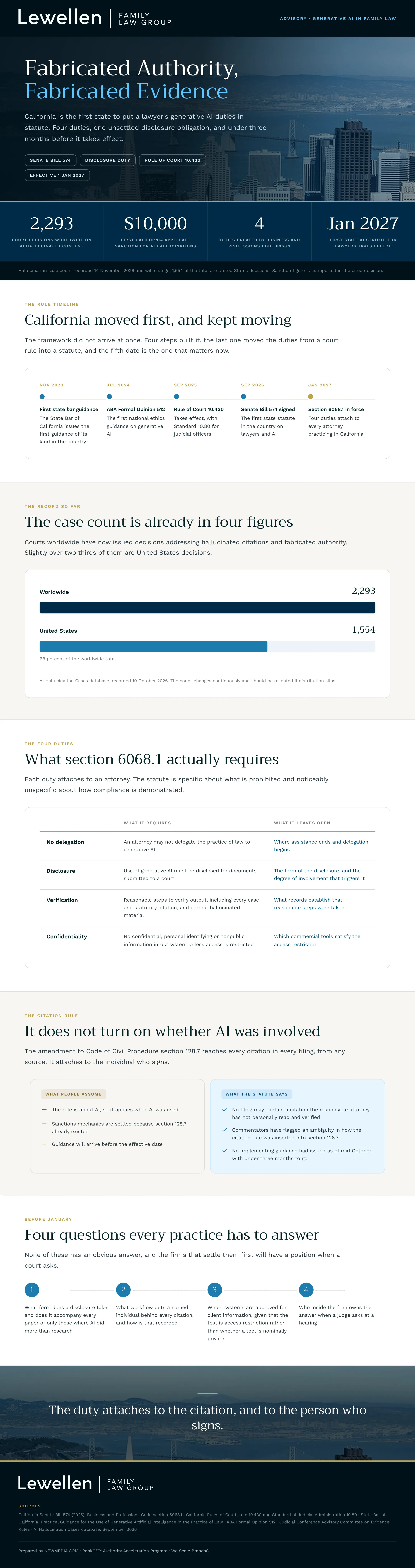
An advisory on the first state statute governing generative artificial intelligence in family law litigation, the sanctions record that preceded it, and the three compliance questions every California firm has to answer before January.
Generative AI in Family Law: Fabricated Authority and Fabricated Evidence
San Francisco, CA, Nov. 19, 2026 (GLOBE NEWSWIRE) -- Lewellen Family Law Group P.C., a Northern California family law firm with offices in San Francisco and Sacramento practicing exclusively in family law, has published an advisory on Senate Bill 574, signed on September 30, 2026, which makes California the first state to place a lawyer's obligations around generative artificial intelligence in statute. The advisory sets out what the statute requires, what it leaves unspecified, and what a practice has to settle before it takes effect on January 1, 2027. The questions it leaves open are already shaping how generative artificial intelligence is used in family law litigation.
Kimberly Lewellen is a Certified Family Law Specialist in California and has provided consultation to venture capitalists and technology founders over the past several years. Amrit Kullar, CIPP/US, CIPP/E, CIPP/C, CIPP/A and AIGP, is a data privacy subject matter expert who has presented on artificial intelligence and the ethics, discovery and family law practice issues that accompany it.
California moved first on the rules
The statute is the third step, not the first. California was already the first state to adopt a court rule governing generative artificial intelligence. Rule of Court 10.430, adopted in July 2025 and effective September 1, 2025, requires any court that does not prohibit generative AI use by court staff or judicial officers to adopt a use policy. Those policies must keep confidential, personal identifying and other nonpublic information out of public generative AI systems, and must require anyone creating or using generative AI material to verify its accuracy and correct hallucinated output. A companion provision, Standard of Judicial Administration 10.80, covers judicial officers acting within their adjudicative role in advisory rather than mandatory language. Both followed a Generative AI Task Force established by Chief Justice Patricia Guerrero in May 2024.
The rule's December 15, 2025 deadline reached every superior court in the state, which means the courts where a California family law matter is actually heard, among them the family law courts in San Francisco and those in Sacramento County, had to settle their own position on generative artificial intelligence a full year before the statute arrived. A practitioner appearing in more than one county is therefore already working under more than one policy.
The State Bar of California moved earlier still. Its Practical Guidance for the Use of Generative Artificial Intelligence in the Practice of Law, first published in November 2023 and revised in May 2026 to address agentic systems, was the first such guidance from any state bar. It is direct on the point that matters most: a lawyer's professional judgment cannot be delegated to AI, and neither can the duty of candor to the tribunal. The American Bar Association issued Formal Opinion 512, its first ethics guidance on generative AI, in July 2024.
On September 30, 2026 the framework moved from court rule into statute. Governor Gavin Newsom signed Senate Bill 574, authored by Senator Thomas Umberg, which passed the Legislature unanimously. California is now the first state in the country to place a lawyer's obligations around generative artificial intelligence in a statute rather than only in a rule of court or a bar guidance document. The bill carries no urgency clause, so it takes effect on January 1, 2027.
SB 574 adds section 6068.1 to the Business and Professions Code and section 1282.1 to the Code of Civil Procedure, and amends Code of Civil Procedure section 128.7 among other provisions. Section 6068.1 carries four duties. An attorney may not delegate the practice of law to generative artificial intelligence. An attorney must disclose the use of generative artificial intelligence for documents submitted to a court. An attorney must take reasonable steps to verify the accuracy of generative AI output, including all case and statutory citations, and correct any erroneous or hallucinated output. And an attorney may not enter confidential, personal identifying or other nonpublic information into a generative AI system unless access is limited to the attorney and persons bound by the same duty of confidentiality.
The disclosure duty is the one with the widest reach, and it is the one the Judicial Council led with when the statute was signed. It is also the least specified. The statute does not state the form the disclosure must take, and it does not set the threshold of AI involvement that triggers it. A lawyer who used a research tool to locate an authority and a lawyer who generated a first draft are both within the text, and neither has guidance on what to file. That question will be answered by local practice and by individual judges before it is answered by anyone else.
The amendment to Code of Civil Procedure section 128.7 has the sharpest edge. A brief, pleading, motion or other paper filed in any court may not contain a citation that the attorney responsible for submitting it has not personally read and verified. That obligation does not turn on whether AI was involved. It attaches to the citation, and it attaches to a named individual. Violations run through the existing sanctions machinery of section 128.7 and through State Bar discipline. Parallel duties apply to arbitrators and alternative dispute resolution providers, who may not delegate decision making to generative AI and must disclose AI generated information used in a matter.
Commentators have flagged an ambiguity in how the citation rule was inserted into section 128.7. On one reading, the protection that ordinarily shields a represented party from monetary sanctions attaches to the new citation provision rather than to the frivolous legal contention provision it was drafted against. Whether that was intended is unclear, and it may require either a legislative correction or a judicial answer. Until one arrives, the prudent assumption is that the duty is personal to the attorney who signs, which is how the statute reads on its face.
The sanctions record is no longer anecdotal
The statute arrives on top of an established record. A public tracker maintained by researcher Damien Charlotin documented 2,293 court decisions worldwide addressing AI generated hallucinated content as of November 14, 2026, of which 1,554 were in the United States. The tracker counts only matters where a court explicitly found or implied that a party relied on hallucinated content, rather than cases where the use of AI was merely alleged.
California's own record is now among the most developed of any state. On September 12, 2025, in Noland v. Land of the Free, L.P., the Court of Appeal for the Second Appellate District, Division Three, issued what is understood to be the state's first published appellate opinion sanctioning a lawyer for AI fabricated citations. It imposed a $10,000 sanction and directed that the opinion be forwarded to the State Bar. The court's statement of the duty was unqualified: before filing any court document, an attorney must carefully check every case citation, fact and argument to make sure that they are correct and proper, and attorneys cannot delegate that role to AI, computers, robots, or any other form of technology.
In the federal courts of California, a special master in the Central District imposed sanctions exceeding $31,000 in May 2025 against two firms whose ten page brief contained fabricated authority, finding the combination of undisclosed AI use, failure to check citations and resubmission of a defective brief to be reckless. In January 2026 the California Supreme Court directed the Third Appellate District to issue an order to show cause regarding sanctions over a prosecutor's filing that allegedly cited fabricated authority.
Family law is not insulated
Family courts have not been spared, and the leading case is a dissolution. In March 2026 the Nebraska Supreme Court struck an appellant's brief, dismissed the appeal and referred counsel to its Counsel for Discipline in a marriage dissolution matter involving custody and property division. The court catalogued defective citations throughout the brief, including entirely fictitious cases, real cases given fabricated quotations, real cases given holdings they do not contain, and fabricated quotations from a Nebraska statute and from court rules, and noted there were many more than the ones it listed. In the disciplinary proceeding that followed, 57 of the brief's 63 citations were identified as defective. The court suspended the attorney from practice the following month pending a full disciplinary hearing.
The court's framing deserves attention from anyone treating this as a technology question. It held that conscious avoidance, or a failure to adequately review a brief and verify that the law presented is good law, satisfies the knowing element of the duty of candor regardless of whether AI was involved. The rule being enforced is not a new AI rule. It is the existing obligation to read what you cite.
Kimberly Lewellen, a California Board Certified Family Law Specialist and the firm's shareholder, says the practical risk in family law is distinctive.
“In a complex family law case an AI generated hallucinated legal citation, incorrect assumption or factual falsehood gets caught and the parties argue about sanctions. In a financial case the same failure can cost thousands if not hundreds of thousands of dollars before anyone fully untangles it, given the expediency of the proceedings and the complexity of the issues. The consequences are not symmetric, and the correction is not always retroactive if the mistake was preventable.”
What compliance looks like before January
The statute takes effect on January 1, 2027, and as of this advisory no implementing guidance, advisory opinion or rules proposal interpreting it has issued from the Judicial Council or the State Bar. Firms have under three months to decide, without official direction, what their own practice will be.
Three questions have to be answered inside each firm. What form will a disclosure take, and will it be filed with every paper or only those where generative AI played a role beyond research. What verification workflow puts a named individual behind every citation, and how is that recorded. And which systems are approved for client information, given that the confidentiality restriction turns on whether access is limited to the attorney and persons bound by the same duty rather than on whether a tool is nominally private.
None of those answers is obvious, and the firms that work them out before January will be the ones with a position when a court first asks. The firms that wait will be answering in the moment.
Lewellen says the firm's position is not that the tools should be avoided.
“The advantage goes to the side that knows how to use these tools and knows when the output is wrong, including when the output is coming from the other side. Those are different skills, obtained only through subject matter experience and knowledge, and they likely decide cases.”
The firm keeps that capability inside the practice. Amrit Kullar, a senior attorney, holds the Artificial Intelligence Governance Professional credential from the International Association of Privacy Professionals, which certifies competency in AI governance, risk management and the law applying to AI systems, alongside privacy certifications covering the United States, Europe, Canada and Asia. The combination of an AI governance credential and representation in contested family law matters is uncommon.
Frequently asked questions
Can my lawyer use AI on my divorce case in California?
Yes. Generative artificial intelligence may be used in family law litigation, subject to four duties that take effect January 1, 2027 under Senate Bill 574. An attorney may not delegate the practice of law to generative AI, must disclose its use for documents submitted to the court, must verify the accuracy of its output including every citation and correct anything hallucinated, and may not put confidential or personal identifying information into a system that is not access restricted. State Bar guidance already required review and correction, and states that professional judgment and the duty of candor cannot be delegated to AI.
What happens if a lawyer files a brief with fake case citations?
A California appellate court imposed a $10,000 sanction and a State Bar referral in 2025, a California federal matter drew sanctions exceeding $31,000, and courts elsewhere have struck briefs and dismissed appeals. Courts have held that conscious avoidance, or a failure to verify cited authority, satisfies the knowing element of the duty of candor whether or not AI was involved.
Does my lawyer have to tell the court they used AI on my case?
From January 1, 2027, yes, for documents submitted to a court in family law litigation. Senate Bill 574 creates an affirmative disclosure duty but does not specify the form the disclosure takes or the degree of AI involvement that triggers it, so practice is likely to vary between courts until guidance or case law settles it.
When does California's AI law for lawyers take effect?
January 1, 2027. Senate Bill 574 was signed on September 30, 2026 and carries no urgency clause, so it takes effect under the ordinary rule for a regular session enactment. No implementing guidance had issued as of November 5, 2026.
Key Facts
|
Related resources
- how Lewellen Family Law Group uses AI in litigation
- legal representation in contested family law matters
- domestic violence and restraining order representation
- California Rules of Court, rule 10.430
- California Senate Bill 574, bill text and status
- State Bar of California ethics and technology resources
- International Association of Privacy Professionals, AIGP certification
About Lewellen Family Law Group P.C.
Lewellen Family Law Group P.C. is a Northern California family law firm with offices in San Francisco and Sacramento. The firm practices exclusively in family law, with emphasis on complex property division, business and professional practice valuation, executive and equity compensation, child custody including interstate and international matters, domestic violence, and mediation. The practice is led by a California Board Certified Family Law Specialist and works with forensic accounting and valuation professionals on complex asset matters and a senior attorney certified in artificial intelligence governance and privacy. The firm serves the San Francisco Bay Area, Silicon Valley, the Napa and Sonoma valleys, and Sacramento, Placer, El Dorado and Yolo counties.
For more information please visit: https://californiafamilylaw.com
# # #







Comments (0)
Login to join the conversation
Login / RegisterNo comments yet. Be the first to comment!