
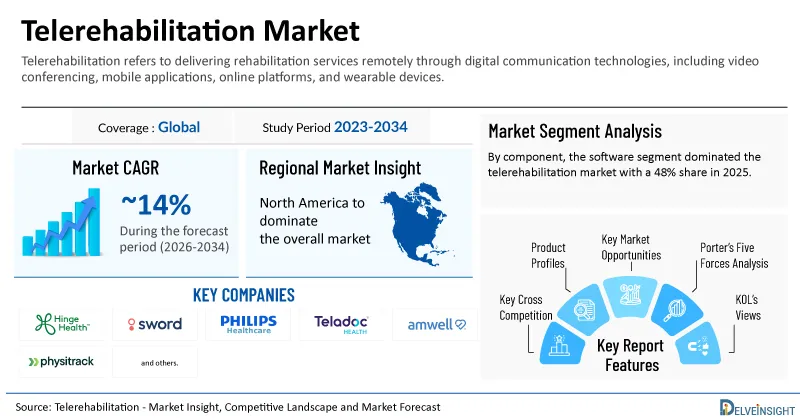
The global telerehabilitation market was valued at USD 5.60 billion in 2025 and is projected to reach USD 18.21 billion by 2034, according to DelveInsight's latest telerehabilitation market insights report.
New York, USA, Nov. 25, 2026 (GLOBE NEWSWIRE) -- Telerehabilitation Market to Observe Stunning Growth at a ~14% CAGR by 2034 | DelveInsight
The global telerehabilitation market was valued at USD 5.60 billion in 2025 and is projected to reach USD 18.21 billion by 2034, according to DelveInsight's latest telerehabilitation market insights report.
The market is expected to grow at a CAGR of approximately 14% during the forecast period (2026–2034), driven by the rising geriatric population, increasing burden of chronic and musculoskeletal conditions, growing demand for accessible and cost-effective home-based rehabilitation, and continuous technological advancements. Software accounted for 48% of the global market in 2025, making it the largest component segment, while physical therapy represented 38% of market revenue. Cloud-based delivery dominated with a 65% share, and hospitals and clinics accounted for 42% of the market. North America led the global market with a 38% revenue share, while Asia-Pacific is projected to register the fastest growth through 2034. Looking ahead, the integration of artificial intelligence, wearable sensors, motion-capture technologies, and virtual reality, alongside expanding digital healthcare infrastructure and reimbursement pathways, is expected to shape the competitive landscape.
DelveInsight’s Telerehabilitation Market Insights report provides the current and forecast market analysis, individual leading telerehabilitation companies’ market shares, challenges, telerehabilitation market drivers, barriers, trends, and key telerehabilitation companies in the market.
Telerehabilitation Market Summary
- 2025 Telerehabilitation Market Size: USD 5.6 Billion
- 2034 Projected Telerehabilitation Market Size: USD 18.2 Billion
- Telerehabilitation Market Growth Rate (2026-2034): ~14%
- Largest Telerehabilitation Market: North America
- Largest Component Segment: Software Category (48%)
- Largest Application Segment: Physical Therapy Category (38%)
- Largest Mode of Delivery Segment: Cloud-based Category (65%)
- Fastest-growing Region: Asia-Pacific (as projected)
- Key Companies in the Telerehabilitation Market: Hinge Health, Inc., SWORD Health, Koninklijke Philips N.V., Teladoc Health, Inc., American Well Corporation (Amwell), Physitrack PLC, Zimmer Biomet Holdings, Inc., DarioHealth Corp., Included Health, Inc., MedBridge, Vori Health, Care Innovations, LLC, MIRA Rehab Limited, Rehametrics, PT Genie, NeuroTechR3, Inc., and others.
Source: DelveInsight, Telerehabilitation Market Insights, Competitive Landscape, and Market Forecast – 2034. Market estimates are based on DelveInsight's research and forecasting methodology.
Request a free sample page to know the full forecast of the telerehabilitation market @ https://www.delveinsight.com/report-store/telerehabilitation-market
Himanshu Agnihotri, Project Manager of Healthcare Consulting at DelveInsight, said that the growing adoption of digital health technologies, including remote patient monitoring, wearable devices, AI-enabled rehabilitation platforms, and virtual physical therapy solutions, is transforming traditional rehabilitation delivery models. Additionally, the increasing preference for home-based care, coupled with advancements in telehealth infrastructure and favorable government initiatives supporting digital healthcare, is creating lucrative growth opportunities.
Key Factors Contributing to the Rise in Growth of the Telerehabilitation Market
- Increasing Prevalence of Chronic and Musculoskeletal Disorders: The rising incidence of musculoskeletal conditions, neurological disorders, cardiovascular diseases, and physical disabilities is driving demand for rehabilitation services. Telerehabilitation enables patients to access continuous therapeutic interventions and recovery support without frequent hospital visits.
- Growing Adoption of Telehealth and Digital Healthcare Solutions: The increasing integration of telehealth platforms, digital health applications, and remote patient monitoring technologies is supporting the expansion of telerehabilitation services. Healthcare providers are increasingly adopting virtual rehabilitation models to improve accessibility and continuity of care.
- Rising Demand for Home-Based Rehabilitation Services: Patients are increasingly preferring home-based rehabilitation due to convenience, reduced travel requirements, and lower treatment-related expenses. Telerehabilitation enables patients to receive personalized therapy and monitor their recovery while remaining in familiar home environments.
- Increasing Healthcare Expenditure and Focus on Cost-Effective Care: Rising healthcare expenditure and the need to optimize treatment costs are encouraging healthcare providers to adopt remote rehabilitation solutions. Telerehabilitation reduces transportation expenses, minimizes hospital visits, and supports efficient utilization of healthcare resources.
- Growing Geriatric Population and Rehabilitation Needs: The expanding global geriatric population is contributing to increased demand for rehabilitation services associated with age-related mobility limitations, stroke, arthritis, and balance disorders. Telerehabilitation offers older adults convenient access to therapy while reducing the challenges associated with traveling to healthcare facilities.
- Technological Advancements in Digital Rehabilitation Platforms: Advancements in artificial intelligence, wearable devices, virtual reality, motion tracking, and remote monitoring technologies are enhancing the effectiveness of telerehabilitation. These innovations facilitate real-time assessment, personalized exercise programs, progress tracking, and interactive rehabilitation experiences.
- Increasing Focus on Post-Surgical and Post-Acute Care Rehabilitation: The growing volume of orthopedic surgeries, joint replacements, neurological procedures, and cardiovascular interventions is generating demand for postoperative rehabilitation. Telerehabilitation supports continuous recovery monitoring and structured therapy following hospital discharge.
- Expansion of Healthcare Infrastructure and Internet Connectivity: Improvements in broadband connectivity, smartphone penetration, and digital healthcare infrastructure are facilitating wider adoption of telerehabilitation. These developments are particularly important in rural and underserved areas, where access to specialized rehabilitation professionals remains limited.
- Favorable Government Initiatives and Telehealth Reimbursement Policies: Government initiatives promoting digital healthcare, remote patient monitoring, and telemedicine are supporting the adoption of telerehabilitation services. Favorable reimbursement policies and regulatory frameworks in several markets are encouraging healthcare providers to incorporate virtual rehabilitation into clinical practice.
- Increasing Demand for Personalized and Continuous Rehabilitation Care: The growing emphasis on patient-centered healthcare is driving demand for personalized rehabilitation programs tailored to individual recovery needs. Telerehabilitation enables therapists to monitor patient progress, modify treatment plans, and provide continuous guidance, thereby improving patient engagement and adherence to therapy.
- Growing Adoption of Telerehabilitation in Sports and Physical Therapy: Increasing participation in sports and physical activities, along with rising sports-related injuries, is driving demand for remote physiotherapy and rehabilitation services. Telerehabilitation allows athletes and active individuals to receive recovery guidance, exercise supervision, and performance monitoring remotely.
- Strategic Collaborations and Investments in Digital Rehabilitation: Increasing investments by healthcare technology companies, rehabilitation providers, and digital health startups are accelerating the development of innovative telerehabilitation platforms. Strategic collaborations are expanding service offerings, improving technological capabilities, and strengthening market penetration.
Get a sneak peek at the telerehabilitation market dynamics @ Telerehabilitation Market Trends
Regional Telerehabilitation Market Insights
North America Telerehabilitation Market Analysis
- North America captured a 38% share of the global telerehabilitation market in 2025 and is anticipated to maintain its dominance throughout the forecast period.
- The region's leadership is supported by its well-established healthcare infrastructure, favorable telehealth policies and reimbursement frameworks, widespread adoption of virtual care, a substantial burden of chronic and musculoskeletal disorders, and the presence of prominent digital rehabilitation providers.
- The United States represents the largest and most mature telerehabilitation market, with adoption accelerating amid the growing transition toward virtual consultations, regulatory reforms, and expanded Medicare telehealth flexibilities that have improved access to remote healthcare services.
- Furthermore, the region faces a considerable rehabilitation demand, with the Centers for Disease Control and Prevention (CDC) reporting that 6 in 10 U.S. adults have a chronic disease.
- This demand is complemented by a well-capitalized digital health ecosystem and increasing adoption of digital musculoskeletal care programs by employers and health plans seeking to address a major healthcare expenditure category.
- The presence, commercial scale, and technological capabilities of leading telerehabilitation and digital musculoskeletal companies, several headquartered in North America, further reinforce its competitive position.
- The region also remains at the forefront of investment, innovation, and commercialization in telerehabilitation, serving as a key launch and expansion market for leading platforms. These factors are expected to sustain North America's leading position over the forecast period.
Europe Telerehabilitation Market Analysis
- Europe accounted for a significant share of the global telerehabilitation market in 2025 and is expected to witness substantial growth throughout the forecast period.
- The region's market expansion is supported by its well-established healthcare infrastructure, increasing adoption of digital healthcare technologies, favorable government initiatives promoting telehealth, rising prevalence of chronic and musculoskeletal disorders, and growing demand for accessible and cost-effective rehabilitation services.
- Countries such as Germany, the United Kingdom, France, Italy, and Spain represent key markets for telerehabilitation, supported by established healthcare systems, increasing investments in digital health, and expanding rehabilitation service requirements.
- The region's rapidly aging population represents a major growth driver, as age-related conditions, including stroke, neurological disorders, osteoarthritis, and mobility impairments, contribute to increasing demand for physical, occupational, and speech therapy services.
- Furthermore, the growing emphasis on reducing healthcare expenditure, improving patient outcomes, and minimizing hospital readmissions is encouraging healthcare providers to integrate remote rehabilitation solutions into conventional care pathways.
- Government-led digital health strategies, supportive reimbursement developments, and investments in healthcare technology are further strengthening the adoption of telerehabilitation across European healthcare systems.
- The region is also benefiting from increasing integration of virtual rehabilitation platforms, remote patient monitoring technologies, wearable devices, and digital therapeutic solutions, enabling continuous assessment and personalized rehabilitation outside conventional clinical settings.
- Germany's market is supported by its advanced healthcare infrastructure and growing adoption of digital health applications, while the United Kingdom benefits from increasing digital healthcare integration and initiatives aimed at improving access to rehabilitation services through the National Health Service (NHS).
- France and Italy are witnessing expanding opportunities owing to aging demographics, increasing rehabilitation requirements, and growing investments in healthcare digitalization.
- Collectively, these factors are expected to support Europe's sustained expansion in the telerehabilitation market throughout the forecast period.
Asia-Pacific Telerehabilitation Market Analysis
- Asia-Pacific is anticipated to record the fastest CAGR in the telerehabilitation market through 2034, positioning the region as a major growth contributor.
- Market expansion is being driven by large and aging populations, an increasing prevalence of chronic and musculoskeletal disorders, rising demand for physical, occupational, and speech therapy services, growing investments in healthcare digitalization, and the need to improve healthcare accessibility across rural and underserved communities in China, Japan, India, and other regional economies.
- The combination of substantial population bases, rapidly aging demographics, an expanding rehabilitation burden, and limited access to conventional healthcare services in rural areas creates significant opportunities for remote rehabilitation delivery.
- Increasing investments in digital healthcare infrastructure, the expansion of hospitals and rehabilitation centers, technological advancements, and government initiatives aimed at improving healthcare accessibility and promoting healthier lifestyles are further supporting market growth.
- The region's extensive rural and geographically dispersed populations particularly benefit from telerehabilitation's ability to overcome distance and accessibility barriers.
- Japan's market growth is supported by its rapidly aging population, technological sophistication, and increasing demand for home-based rehabilitation services.
- China benefits from its large population, rising healthcare digitalization investments, and initiatives to strengthen rural healthcare access, while India is witnessing expanding opportunities through its growing population and rapidly developing digital health ecosystem.
- Collectively, these factors are expected to drive Asia-Pacific's growth above the global market average across all segments during the forecast period.
To know more about why North America is leading the market growth in the telerehabilitation market, get a snapshot of the Telerehabilitation Market Analysis
Recent Developmental Activities in the Telerehabilitation Market
- In October 2026, the RehaBot platform introduced chatbot-based telerehabilitation for cerebral palsy.
- In September 2026, the TELECOR randomized trial evaluated telerehabilitation against conventional centre-based cardiac rehabilitation in patients recovering from acute coronary syndrome, examining cardiovascular risk-factor control and lifestyle adherence.
- In January 2026, SWORD Health acquired the Munich-based digital musculoskeletal company Kaia Health in a deal valued at USD 285 million, folding Kaia’s camera-based motion analysis into its sensor-led model and securing, through Kaia’s approvals, a reimbursement position in Germany’s digital health application pathway.
- In June 2025, Hinge Health launched HingeSelect, a curated referral network of in-person musculoskeletal providers, including imaging centers and brick-and-mortar physical therapy providers, to complement its virtual platform.
- In June 2025, SWORD Health announced a USD 40 million raise, bringing its total funding to some USD 380 million and its valuation to USD 4 billion.
- In May 2025, Hinge Health completed its initial public offering on the New York Stock Exchange, raising USD 437 million with shares rising over 20% above the offering price to a market capitalization of over USD 3 billion, and guided to annual revenue of over USD 570 million.
What is Telerehabilitation?
Telerehabilitation refers to delivering rehabilitation services remotely through digital communication technologies, including video conferencing, mobile applications, online platforms, and wearable devices. It enables healthcare professionals, such as physiotherapists, occupational therapists, speech-language pathologists, and rehabilitation specialists, to assess patients, develop personalized treatment plans, monitor progress, and provide therapeutic interventions without requiring in-person visits. Telerehabilitation supports the management of various conditions, including neurological disorders, musculoskeletal injuries, cardiovascular diseases, and post-surgical recovery, by facilitating continuous care, improving patient engagement, and enhancing accessibility to rehabilitation services. It offers several advantages, including reduced travel requirements, improved convenience, greater access to specialized care, and enhanced continuity of treatment, particularly for individuals living in remote or underserved areas.
| Telerehabilitation Market Report Metrics | Details |
| Coverage | Global |
| Study Period | 2023–2034 |
| Telerehabilitation Market CAGR | ~14% |
| Telerehabilitation Market Size by 2034 | USD 18.2 Billion |
| Key Telerehabilitation Companies | Hinge Health, Inc., SWORD Health, Koninklijke Philips N.V., Teladoc Health, Inc., American Well Corporation (Amwell), Physitrack PLC, Zimmer Biomet Holdings, Inc., DarioHealth Corp., Included Health, Inc., MedBridge, Vori Health, Care Innovations, LLC, MIRA Rehab Limited, Rehametrics, PT Genie, NeuroTechR3, Inc., and others |
Telerehabilitation Market Assessment
- Telerehabilitation Market Segmentation
- Telerehabilitation Market Segmentation By Component: Software, Services, and Hardware
- Telerehabilitation Market Segmentation By Application: Physical Therapy, Occupational Therapy, Speech Therapy, Cardiac Rehabilitation, Neurological Rehabilitation, and Others
- Telerehabilitation Market Segmentation By Mode of Delivery: Cloud-Based, On-Premise, and Web-Based
- Telerehabilitation Market Segmentation By End-User: Hospitals and Clinics, Home Care Settings, Rehabilitation Centers, and Others
- Telerehabilitation Market Segmentation By Geography: North America, Europe, Asia-Pacific, and Rest of World
- Porter’s Five Forces Analysis, Product Profiles, Case Studies, KOL’s Views, Analyst’s View
Which MedTech key players in the telerehabilitation market are set to emerge as the trendsetter explore @ Telerehabilitation Market Size
Table of Contents
| 1 | Telerehabilitation Market Report Introduction |
| 2 | Telerehabilitation Market Executive Summary |
| 3 | Telerehabilitation Market Key Factors Analysis |
| 4 | Impact Analysis |
| 5 | Regulatory Analysis |
| 6 | Telerehabilitation Market Porter’s Five Forces Analysis |
| 7 | Telerehabilitation Market Assessment |
| 8 | Competitive Landscape |
| 9 | Startup Funding & Investment Trends |
| 10 | Telerehabilitation Market Company and Product Profiles |
| 11 | KOL Views |
| 12 | Project Approach |
| 13 | About DelveInsight |
| 14 | Disclaimer & Contact Us |
Interested in knowing the telerehabilitation market share by 2034? Click to get a snapshot of the Top Telerehabilitation Companies
Related Reports
Medical Rehabilitation Services Market Insight, Competitive Landscape, and Market Forecast – 2034 report delivers an in-depth understanding of market trends, market drivers, market barriers, and key medical rehabilitation services companies such as Encompass Health Corporation, Select Medical Holdings Corporation, U.S. Physical Therapy, Inc., ATI Holdings, LLC, and Concentra Group Holdings Parent, Inc., alongside Enhabit, Inc., Brooks Rehabilitation, Kessler Institute for Rehabilitation, Shirley Ryan AbilityLab, and others.
Physical Therapy Market Insight, Competitive Landscape, and Market Forecast – 2034 report delivers an in-depth understanding of market trends, market drivers, market barriers, and key physical therapy companies such as Select Medical, ATI Physical Therapy, Upstream Rehabilitation, U.S. Physical Therapy, Athletico Physical Therapy, Encompass Health, FYZICAL Therapy & Balance Centers, PT Solutions Physical Therapy, Ivy Rehab Network, CORA Physical Therapy, and others.
Musculoskeletal Pain Market Insights, Epidemiology, and Market Forecast – 2036 report delivers an in-depth understanding of the disease, historical and forecasted epidemiology, as well as the market trends, market drivers, market barriers, and key musculoskeletal pain companies, including Mesoblast, Taiwan Liposome Company, Biosplice, Centrexion Therapeutics, Latigo Biotherapeutics, Pacira BioSciences, Contineum Therapeutics, Tris Pharma, and others.
Degenerative Disc Disease Market Insights, Epidemiology, and Market Forecast – 2036 report deliver an in-depth understanding of the disease, historical and forecasted epidemiology, as well as the market trends, market drivers, market barriers, and key degenerative disc disease companies, including Spine Biopharma, DiscGenics, Mesoblast, Grünenthal, AnGes, BioRestorative Therapies, Kolon TissueGene, Citospin, Creative Medical Technology, and others.
Chronic Lower Back Pain Market Insights, Epidemiology, and Market Forecast – 2036 report deliver an in-depth understanding of the disease, historical and forecasted epidemiology, as well as the market trends, market drivers, market barriers, and key CLBP companies, including Scilex Holding (Semnur Pharmaceuticals), Eli Lilly, Spine BioPharma, DiscGenics, Mesoblast, Grünenthal, AnGes, Shionogi, Tris Pharma (Adneuris Therapeutics), BioRestorative Therapies, Stayble Therapeutics, Persica Pharmaceuticals, Kolon Life Science, Creative Medical Technology, and others.
About DelveInsight
DelveInsight is a leading Business Consultant and Market Research firm focused exclusively on life sciences. It supports pharma companies by providing comprehensive end-to-end solutions to improve their performance. Get hassle-free access to all the healthcare and pharma market research reports through our subscription-based platform PharmDelve.
CONTACT: Contact Us

Shruti Thakur

info@delveinsight.com

+14699457679





Comments (0)
Login to join the conversation
Login / RegisterNo comments yet. Be the first to comment!