
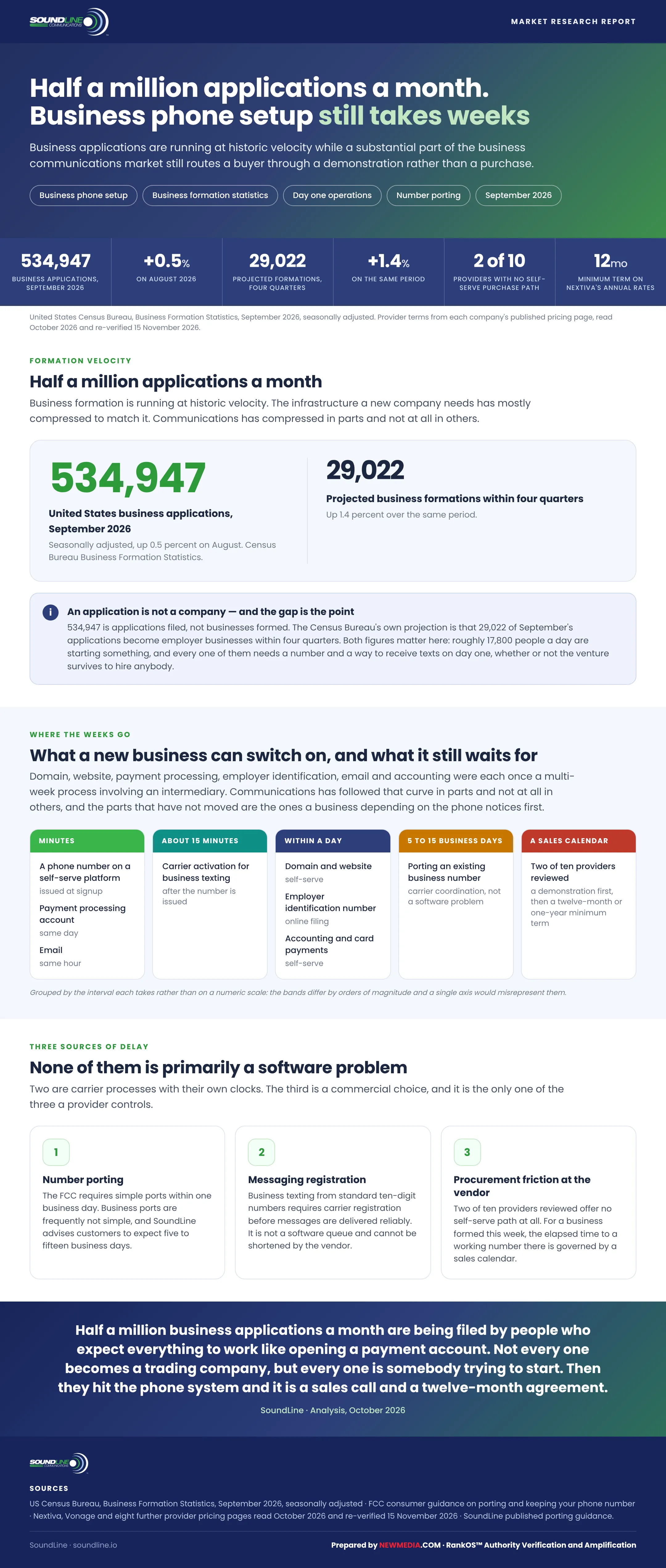
Analysis of the gap between the rate at which new United States businesses are created and the time required to obtain the operating infrastructure they need on day one.
New Business Phone Setup - Why Does It Take Weeks, vs 500,000 New Business Applications Every Month
Redmond, Washington, United States, Nov. 25, 2026 (GLOBE NEWSWIRE) -- United States business applications reached 534,947 in September 2026, seasonally adjusted, according to the Census Bureau's Business Formation Statistics, yet business phone setup for a new business remains a multi-week process at a substantial part of the market. An analysis published in October 2026 by SoundLine examines the gap between formation velocity and the infrastructure available to new companies.
The Census figure was up 0.5 percent on August 2026. Projected business formations within four quarters stood at 29,022, up 1.4 percent over the same period.
SoundLine published this analysis and sells the services it describes, and therefore has a commercial interest in its conclusions.
What business phone setup for a new business can deliver immediately
The analysis distinguishes between infrastructure that has been compressed to minutes and infrastructure that has not.
A new company can register a domain, stand up a website, open a payment processing account, file for an employer identification number, establish email and accounting, and begin accepting card payments, in most cases within a day and frequently within an hour. Each of those was once a multi-week process involving an intermediary.
Communications has not followed the same curve uniformly. Parts of it have: a number can be issued in minutes on a self-serve platform. Other parts have not moved at all, and the analysis argues the unmoved parts are the ones that matter most to a business that depends on the phone.
Where the weeks in business phone setup actually go
Three processes account for most of the delay, and none is primarily a software problem.
- Number porting. A business moving an existing number is subject to carrier coordination. The Federal Communications Commission requires simple ports, generally a single line without complex switching arrangements, to be processed within one business day. Business ports are frequently not simple: multi-line accounts, numbers attached to hunt groups or PBX configurations, and accounts with billing discrepancies all fall outside that category. The existing number keeps working for the whole transfer, and SoundLine charges nothing to bring one in.
- Messaging registration. Business texting from standard ten-digit numbers requires registration before carriers will deliver it reliably, a process examined in detail in an analysis of how messaging approval actually works.
- Procurement friction at the vendor. Of ten providers reviewed in October 2026, two do not offer a self-serve path at all. Nextiva's pricing page offers a demonstration, and its published small-business rates depend on a twelve-month or longer term agreement. Vonage publishes no free trial on the plans reviewed and requires a minimum one-year commitment on new annual accounts. For a business formed this week, the elapsed time to a working number at those providers is governed by a sales calendar.
What closes and what does not
The analysis separates the components of the delay by whether they are addressable by a provider.
Addressable: the signup path, identity verification, number selection, plan configuration and the decision to offer self-serve at all. SoundLine's measured interval from account creation to a first call is under five minutes, recorded on screen capture in October 2026, and the company reports that two steps were removed from the flow earlier that month to shorten it.
Partly addressable: messaging registration. The framework is external, but whether a provider performs the registration or hands the customer a form is a provider decision, and the difference is material to a business owner with no prior exposure to campaign categories.
Not addressable: the carrier coordination underlying number porting. A provider can set expectations accurately and sequence the work sensibly. It cannot compress the process, and the analysis notes that claims to the contrary should be treated skeptically.
What the formation data does and does not show
The analysis is deliberate about the limits of the Census series it cites.
Business applications are filings, not operating companies. The Census Bureau publishes a separate projection of business formations expected to result in payroll within four quarters, which stood at 29,022 in September 2026 against 534,947 applications in the same month. The ratio between those two figures is not a measure of failure; most applications are sole proprietorships and single-member entities that will never carry payroll, and many of those are functioning businesses.
What the series does establish is the rate at which new legal entities requiring operating infrastructure are being created, which is the relevant figure for this analysis regardless of how many later add employees.
The analysis also notes that application volume has been elevated relative to the pre-2020 baseline for several years, so the observation is about a sustained level rather than a recent surge, and the infrastructure gap it describes is correspondingly long-standing rather than new.
What a new business actually needs on day one
The analysis proposes that the day-one requirement is narrower than most guidance suggests, and that over-specifying it is itself a source of delay.
Three things have to work before a customer can reach a new business: a number that is not the founder's personal mobile, a way for people to reach the business when nobody answers, and a way to be found and booked if the business takes appointments.
The analysis argues the rest can wait. Desk phones belong where there is a desk and somebody sitting at it. An auto attendant belongs where there are departments to route to. Extensions follow hiring. A toll-free number signals national scale and does nothing for a business whose customers are local.
The separation matters because the most consequential day-one decision is the cheapest one: establishing a business number distinct from the founder's personal line. A personal number placed on invoices, listings and vehicles cannot later be delegated, cannot be separated from the individual if the business is sold, and cannot be made to stop ringing. Changing it in year three means notifying every customer.
Four routes to a business number, and what each one can and cannot do, are set out at soundline.io.
What day one used to require
The comparison is worth stating because it establishes how far the rest of the stack has moved.
Opening a business bank account required an appointment. Accepting card payments required a merchant account, underwriting and a terminal. Incorporating required a lawyer or a filing service and took weeks. A website required a developer. Each of those has been compressed to a same-day, self-serve process, in most cases within the last fifteen years.
Business telephony has moved unevenly against that benchmark. Obtaining a number has compressed as far as any of them. Transferring an existing number has not moved at all, because it depends on coordination between carriers rather than on any single provider's systems. Messaging registration did not exist as a requirement until relatively recently and has added time rather than removed it.
The uneven result is the specific thing the analysis is describing: a new business can be incorporated, banked, insured and accepting payments before it can reliably text a customer.
Why the business phone setup gap has not closed on its own
Three structural reasons account for the persistence of the gap, and the analysis argues that only one of them is likely to resolve without deliberate effort.
The first is that telecommunications carries regulatory obligations that software categories do not. Emergency calling, number portability and messaging registration each involve external parties, defined processes and, in the case of emergency service, statutory requirements. Compressing those is not a matter of better engineering.
The second is that a substantial part of the category sells to organizations rather than to individuals, and an organization expects a procurement process. A provider optimized for that buyer has no commercial reason to build a self-serve path, and several have not.
The third, which is addressable, is habit. The multi-week timeline was once a genuine constraint for every part of the process, and parts of the category still operate as though it remains one, having never revisited assumptions formed when it did.
The analysis suggests the gap narrows where providers separate the components they control from those they do not, publish honest timelines for both, and stop treating a sales conversation as a necessary step for a customer who did not ask for one.
Questions buyers ask
How many new businesses are being formed in the United States?
Business applications reached 534,947 in September 2026, seasonally adjusted, up 0.5 percent on the prior month, according to the Census Bureau's Business Formation Statistics. Projected business formations within four quarters stood at 29,022.
What do I need to set up a business phone on day one?
A number separate from the founder's personal mobile, a greeting and voicemail in the business name that reaches somebody, and a booking method if the business takes appointments. Desk phones, auto attendants, extensions and toll-free numbers can follow.
How long does it take to set up a business phone system?
On a self-serve platform, minutes to a working number; SoundLine's measured interval is under five minutes. Porting an existing number runs on its own clock, and business texting requires separate carrier registration.
Should I use my personal number when starting a business?
It works initially and is difficult to reverse. A personal number cannot be delegated to staff, cannot carry a business greeting, and cannot be separated from the individual if the business is sold or closed.
Key facts
|
Related resources
- day one communications for a new company
- the routes to a business number
- why a new number cannot text immediately
- number porting, start to finish
- Free business phone numbers: what you actually get
- US Census Bureau Business Formation Statistics
About SoundLine
SoundLine is the communication platform for founders. Voice, text and video in one platform, in your pocket, with one login for every business you run. Based in Redmond, Washington, SoundLine has operated its own voice network since 2008, serving businesses across the United States with business phone numbers, text messaging, video meetings, appointment scheduling and US-based support. Feature availability varies by plan.
For more information please visit: https://soundline.io
# # #






Comments (0)
Login to join the conversation
Login / RegisterNo comments yet. Be the first to comment!