
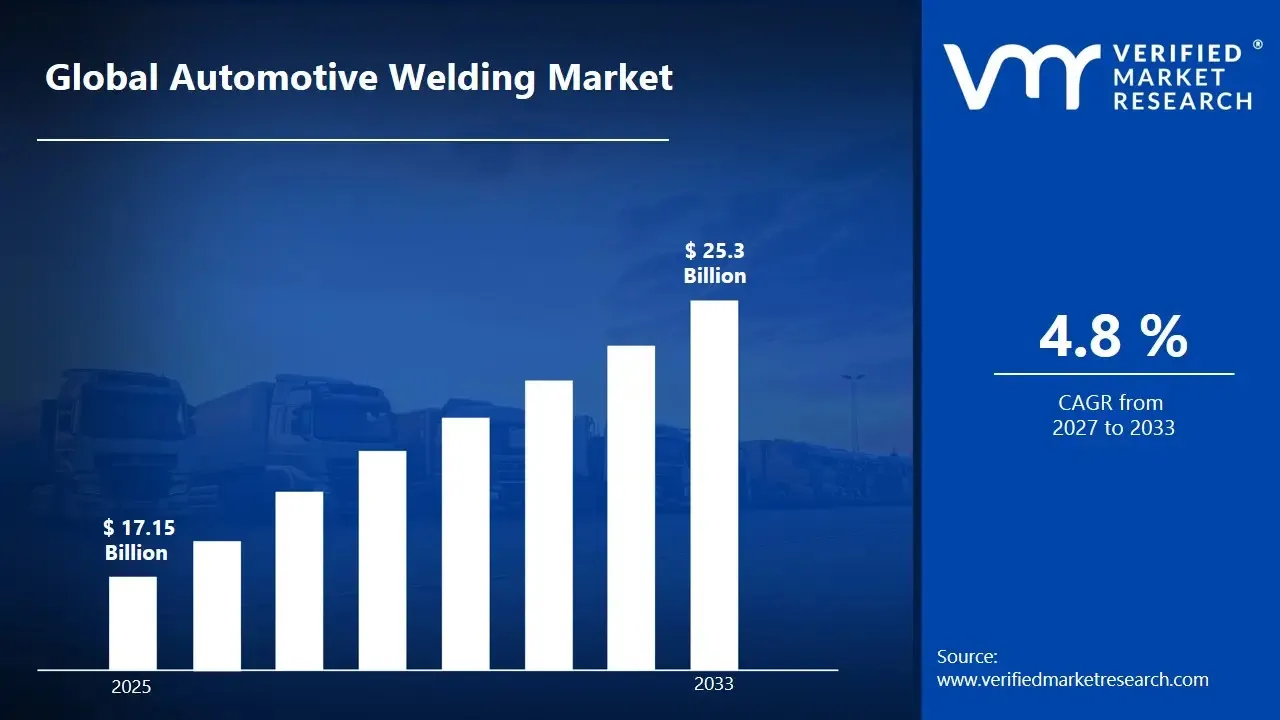
The Global Automotive Welding Market is expanding steadily as OEMs and aftermarket operators invest in higher-precision joining technologies to support lightweight vehicle architectures, tighter compliance requirements, and automation-ready production lines. Body-in-White welding remains the dominant application, underpinned by productivity and distortion-control needs, while Asia Pacific leads global consumption on the strength of China and India automotive production. The Automotive Welding Industry is transitioning toward a segmented process portfolio in which resistance and arc welding anchor high-volume assembly while laser welding and friction stir welding gain targeted share in lightweighting and aluminum-intensive programs. According to Verified Market Research®, this evolution is being reinforced by sustained capital investment from major automakers pursuing welding technology m
Lewes, Delaware, Nov. 13, 2026 (GLOBE NEWSWIRE) -- The Global Automotive Welding Market Size was valued at USD 17.15 Billion in 2025 and is projected to reach USD 25.30 Billion by 2033, registering a compound annual growth rate (CAGR) of 4.8% over the 2025–2033 forecast period, according to a new industry analysis published by Verified Market Research®. The Automotive Welding Market Report provides a comprehensive assessment of market size, growth drivers, restraints, opportunities, competitive landscape, and regional dynamics, offering stakeholders a data-driven view of how the Automotive Welding Industry is expected to evolve across the forecast horizon. The report's coverage spans five regions, nine market segments, and nine key players profiled across more than 240 pages of detailed analysis.
Verified Market Research® notes that the Automotive Welding Market Growth trajectory reflects steady demand expansion alongside a gradual shift in the welding methods used across modern vehicle manufacturing. Rather than accelerating sharply, the market is expanding in a structural, cost-and-process-driven manner, supported by continued integration of welding automation, incremental adoption of higher-precision joining methods, and periodic upgrades to welding lines that align with changing vehicle architectures and compliance requirements.
Download a free sample to access exclusive Insights, Data Charts, And Forecasts From Automotive Welding Market Sample Report
Market Overview
The Automotive Welding Market is defined as the commercial demand for welding solutions used to join, reinforce, and assemble vehicle structures and components across the production and servicing lifecycle. The market captures welding technologies and their adoption through manufacturing and repair processes where the primary value is created by forming reliable, compliant joints between automotive-grade metals and alloys. These joints are engineered for outcomes intrinsic to welding, including structural integrity, dimensional stability, fatigue resistance, and manufacturability under production constraints.
Participation in the Automotive Welding Market is limited to the welding-related technology layer and its use in automotive-specific applications, including Resistance Welding, Arc Welding, Laser Welding, and Friction Stir Welding. The scope also includes welding use-cases where the end application is directly connected to automotive assembly or automotive component repair, spanning Body-in-White, Chassis, and Powertrain categories. In addition, the market recognizes two distinct end-user contexts OEMs, which reflect demand driven by vehicle platform engineering and multi-year production planning, and Aftermarket, which reflects demand driven by fleet and individual vehicle maintenance.
To remove ambiguity, several adjacent markets that are commonly conflated with the Automotive Welding Industry are explicitly excluded from the scope. General industrial metal fabrication welding used for non-automotive sectors is excluded because the analysis is limited to vehicle-relevant end uses. The broader automotive joining ecosystem centered on non-welding fastening methods, such as pure mechanical fastening and adhesive-only joining, is also excluded, since welding-specific technologies produce the joint through metallurgical or friction-based mechanisms rather than through different failure modes and process pathways associated with fastening or adhesives. Equipment-only markets that do not reflect automotive welding deployment for vehicle manufacturing or repair use are similarly treated as outside the defined market scope.
The Automotive Welding Market is structurally broken down using four segmentation dimensions Technology, Application, End-User, and Geography that mirror how procurement and deployment decisions occur across automotive programs and repair channels. This segmentation framework allows stakeholders to understand why the Automotive Welding Market evolves unevenly across the forecast horizon rather than expanding uniformly alongside vehicle production volumes.
Download a free sample to access exclusive Insights, Data Charts, And Forecasts From Automotive Welding Market Sample Report
Key Growth Drivers
Verified Market Research® identifies three principal forces propelling Automotive Welding Market Growth from USD 17.15 Billion in 2025 to USD 25.30 Billion in 2033, in line with the industry's 4.8% CAGR. These drivers operate as an interconnected system linking vehicle design targets to joining technology selection across the Automotive Welding Industry.
1. Lightweighting and Joining-Grade Diversification
Automotive OEM engineering increasingly blends high-strength steels, aluminum, and coated materials to improve fuel economy and performance targets. This design shift requires repeatable weld integrity across dissimilar and difficult-to-join material stacks, pushing manufacturers toward process windows that can control heat input, distortion, and penetration. As programs move from concept to production lines, suppliers expand capacity for welding-capable systems that can meet these requirements, directly translating design requirements into orders across Automotive Welding Market technology categories.
2. Cycle-Time and Productivity Imperatives
Vehicle platforms face sustained pressure to reduce takt time while maintaining consistent weld quality and traceability. Welding cells that integrate automation, faster heat generation, and monitored parameter feedback reduce scrap and rework, which makes higher-throughput processes economically attractive. This intensifying factory requirement increases pull from OEM production engineering for welding lines that can sustain stable output, supporting Automotive Welding Market expansion as plants retool and qualify faster production equipment for body, structural, and powertrain assemblies.
3. Quality, Safety, and Compliance Expectations
Regulatory and customer requirements increasingly emphasize weld strength, defect prevention, and documented manufacturing controls. Manufacturers respond by formalizing qualification protocols, non-destructive evaluation practices, and welding parameter recording, which raises the value of systems that deliver predictable results under controlled conditions. As compliance becomes embedded in supplier selection and audit readiness, welding technology adoption becomes less discretionary, increasing demand for proven Automotive Welding Market solutions that can demonstrate consistent performance.
These drivers are reinforced at the ecosystem level by a supply chain that is consolidating welding expertise into production-ready systems. Faster procurement of welding power sources, consumables, sensors, and automation peripherals reduces line-start delays when OEM programs change joining specifications, while standardization of welding procedures and qualification documentation encourages repeatability across plants and lowers the friction of expanding into new platforms.
Emerging Opportunities
The Automotive Welding Market Report identifies several opportunity clusters where capital, innovation effort, and customer demand are most likely to translate into measurable value across the 2025 - 2033 forecast period.
Laser Welding Expansion for Lightweight Body-in-White Architectures
Laser welding offers a pathway to reduce heat input while improving dimensional control, which is increasingly relevant for mixed-material and thin-gauge structures. The opportunity is emerging as OEM design cycles shorten and manufacturability requirements tighten, exposing inefficiencies in legacy joining workflows. Targeting high-throughput joint classes can translate into measurable line-capacity gains and lower rework, improving competitive positioning within the Automotive Welding Industry.
Arc Welding and Automation Upgrades in Powertrain Assembly
Arc welding remains essential for robust powertrain structures, yet inconsistencies in bead geometry and penetration can create downstream reliability issues. This opportunity is emerging as powertrain electrification and thermal management demand tighter tolerances and stronger fatigue performance. Consolidating qualification, monitoring, and fixture strategy can support faster ramp-up and reduce warranty-linked cost exposure for manufacturers operating in the Automotive Welding Market.
Selective Commercialization of Friction Stir Welding for Aluminum-Intensive Chassis
Friction stir welding can address corrosion-sensitive joint needs and distortion control for aluminum-rich chassis sections, though adoption is often constrained by site-level readiness and routing complexity. The timing is improving as vehicle architectures increase aluminum content and buyers seek better life-cycle performance rather than only initial cost. Building standardized material handling, tool management, and qualification packages can unlock new chassis programs and widen addressable volume across the Automotive Welding Market.
At the ecosystem level, the Automotive Welding Market can accelerate through alignment across equipment suppliers, consumables providers, and integrators. Supply chain optimization and localized tooling readiness can reduce commissioning delays, while standardization of weld qualification methods and documentation can enable faster approvals across OEM platforms and production plants.
Download a free sample to access exclusive Insights, Data Charts, And Forecasts From Automotive Welding Market Sample Report
Market Challenges and Restraints
Despite steady Automotive Welding Market Growth, the industry faces structural restraints that shape the pace of technology adoption across OEM and aftermarket channels.
High Qualification and Revalidation Effort
Automotive welding systems used in Body-in-White and chassis manufacturing require repeatable weld quality, with extensive validation of joint integrity, corrosion behavior, and process stability. When a plant changes technology, it must requalify tooling, update work instructions, and prove outcomes under existing warranty and safety expectations. This extends production ramp times, increases engineering labor, and forces line owners to absorb trial risk rather than immediately scaling volumes, causing adoption of new welding technologies to progress more slowly than hardware procurement cycles.
Equipment Cost and Integration Complexity for Laser and Friction Stir Welding
Even when performance is attractive, laser welding and friction stir welding often require higher upfront capital, facility modifications, and tighter control of process parameters than conventional methods. Integration also depends on available utilities, fixturing approach, material qualification, and operator training. These economic and operational frictions shift purchasing decisions toward incremental upgrades, especially where plant utilization is already constrained or where product mix uncertainty delays payback.
Supply and Standardization Gaps in Consumables and Engineering Know-How
Welding performance is sensitive to parameter control, consumable compatibility, and dependable delivery of specialized parts and fixtures. Inconsistent supply conditions and uneven availability of qualified process expertise can cause variability in weld defects and throughput, undermining reliability targets. Plants then respond with higher inspection effort, more conservative parameter windows, or delayed line changes, which reduces profitability and increases operating uncertainty across the Automotive Welding Market.
At the ecosystem level, cross-cutting structural frictions involving supply chain bottlenecks, uneven standardization, and capacity constraints in process engineering reinforce these restraints. Fragmented practices across plants and suppliers create variability in part fit-up expectations, parameter baselines, and acceptance criteria, while lead-time pressure for specialized components and tooling can extend downtime during process transitions.
Technology and Innovation Trends
Technology is the primary mechanism translating industrial welding capability into automaker adoption across body-in-white, chassis, and powertrain manufacturing. In the Automotive Welding Market, innovation influences cycle time, joint quality, material compatibility, and automation readiness, determining whether new processes remain confined to niche lines or scale into full production.
The core technology landscape is shaped by four joining approaches that differ in how they deliver energy to the workpiece, control heat input, and form consistent metallurgical bonds. Resistance welding is used where repeatability and high throughput are prioritized, converting controlled electrical energy into localized fusion at predefined contact points. Arc welding supports broader part geometries and flexible fabrication, particularly for production constraints or repair scenarios that demand adaptability. Laser welding changes the practical boundary for where high precision is feasible, enabling narrow heat-affected zones and supporting complex weld aesthetics and tight edge conditions. Friction stir welding functions as a solid-state joining route that helps manage thermal stress and supports applications where minimizing distortion and preserving material properties is critical to meeting assembly tolerances.
Closed-Loop Process Control for Repeatable Joint Integrity
Across resistance, arc, laser, and friction stir operations, the most consequential improvements are those that reduce sensitivity to variation in material thickness, surface condition, and fit-up. Closed-loop control strengthens the link between setpoints and actual weld formation by monitoring process behavior and compensating before defects propagate into assembly, resulting in greater scalability from pilot lines to volume production.
Material- and Geometry-Adaptive Joining for Lightweight Architectures
Joining challenges intensify as vehicle architectures shift toward mixed-material structures and thinner gauges, especially within body-in-white and adjacent structural systems. Innovation focuses on expanding which material combinations can be joined while preserving required strength and corrosion performance, rather than forcing redesign around a single weld method, expanding design freedom for OEM programs and aftermarket replacement compatibility.
Automation-Ready Welding Systems for Scalable Integration
Technical progress is increasingly measured by how smoothly welding capabilities integrate into flexible, automated production cells. Innovations in motion control, fixture strategy, and welding head behavior target constraints that typically limit scaling, including part misalignment tolerance, accessibility barriers, and changeover time when model variants shift, improving line balancing and reducing downtime for OEMs and aftermarket refurbishment workflows alike.
Industry Use Cases and End Users
The Automotive Welding Market serves two primary end-user categories, each with distinct procurement logic and operational requirements.
OEMs
OEMs typically define application patterns through standardized production architecture. Welding deployment is organized around platform families, repeatable assembly sequences, and qualification-driven process governance, which encourages installation of equipment that can sustain stable throughput and consistent weld performance over long production runs. OEM programs are typically aligned with new vehicle launches and line redesigns, making OEM production planning and multi-year platform engineering the primary driver of new welding line installations and upgrades across the Automotive Welding Market.
Aftermarket
Aftermarket demand follows a different logic, with repair and refurbishment environments placing stronger emphasis on operational flexibility, access to damaged or irregular joints, and the ability to restore structural integrity within unpredictable repair schedules. Aftermarket adoption is tied to service and replacement cycles rather than the continuous build cadence of original production, making this segment more resilient but less influential on total Automotive Welding Market expansion than OEM-driven capital deployment.
By application, the Automotive Welding Market is segmented into Body-in-White, Chassis, and Powertrain use cases, each reflecting different structural and performance requirements.
Body-in-White
Body-in-White assembly targets dimensional stability and consistent weld integrity across extensive panel networks, where cycle time and defect detection drive equipment selection. Body-in-White demand is structurally dominant within the Automotive Welding Market because it represents the largest portion of welded surface area and joint density in conventional vehicle architectures, making it the focus of process optimization and automation investment.
Chassis
Chassis applications prioritize structural performance and controlled distortion, particularly where joints must withstand fatigue and impacts. Chassis segments also sustain meaningful demand due to frequent redesigns aimed at stiffness, durability, and noise-vibration-harshness (NVH) targets, which require consistent welding qualification.
Powertrain
Powertrain assembly tends to be more variant-rich across platforms and suppliers, with joining requirements that can include material diversity and tighter functional tolerances. Powertrain-related welding tends to be more specialized and program dependent, typically resulting in slower or more cyclical spending compared with the high-volume structural segments of the Automotive Welding Market.
Regional Outlook
The Automotive Welding Market exhibits clear geographic segmentation driven by differences in vehicle production patterns, manufacturing maturity, and compliance intensity. Verified Market Research® provides a detailed regional breakdown covering North America, Europe, Asia Pacific, Latin America, and the Middle East & Africa.
North America
In North America, the Automotive Welding Market follows a mature but innovation-led trajectory. Demand is shaped by a dense base of OEM and Tier supplier manufacturing ecosystems, where joining requirements must meet stringent production stability targets for safety-critical components such as body-in-white and chassis assemblies. Regulatory and compliance expectations translate into tighter process documentation, weld inspection discipline, and continuous improvement of quality systems, which favors technologies that can reduce defect rates and rework. Laser welding and friction stir welding are more likely to progress when plants have capital for process validation and when engineering teams can support rapid parameter development for aluminum-steel stacks. The region's consumption patterns also sustain aftermarket repair demand for conventional joining processes, supporting balanced utilization across technology types through 2033.
Europe
Europe's position in the Automotive Welding Market is shaped by regulation-led engineering disciplines, higher system accountability, and a sustained push toward lower environmental impact in manufacturing. EU-wide harmonization and vehicle safety expectations tighten the qualification cycle for welding processes used in Body-in-White and other high-stress assemblies, increasing the value of documented process stability and certification. Compared with other regions, Europe tends to convert electrification, lightweighting, and quality mandates into welding technology requirements earlier, with tighter acceptance criteria for repeatability, distortion control, and inspection outcomes from OEMs through their supply chains.
Asia Pacific
Asia Pacific leads the Automotive Welding Market with approximately 38% market share, driven by China and India automotive production. The region is expanding through a mix of high-volume production growth and accelerating plant localization across industrial corridors. Developed economies such as Japan and Australia typically emphasize process reliability, higher material grades, and tighter quality targets for Body-in-White and powertrain assemblies, while emerging manufacturing hubs such as India and parts of Southeast Asia show faster capacity additions driven by urbanization, rising vehicle affordability, and the scale of local component ecosystems. Verified Market Research® analysis indicates that regional fragmentation shapes adoption pathways, with OEMs prioritizing repeatable joining performance while aftermarkets remain sensitive to repair-driven demand and part replacement cycles.
Latin America
Latin America represents an emerging, gradually expanding segment of the Automotive Welding Market, with demand concentrated in Brazil, Mexico, and Argentina, while other markets remain more sporadic. Growth is shaped by automotive production cycles and uneven industrial capacity, where currency volatility and variable investment timing can delay tooling, supplier qualification, and line modernization. As manufacturing ecosystems mature, welding solutions are adopted progressively across body-in-white and chassis lines, with technology selection reflecting affordability, throughput targets, and the availability of skilled integration support.
Middle East & Africa
The Automotive Welding Market in the Middle East & Africa behaves as a selectively developing landscape rather than a uniformly expanding industry. Gulf economies, alongside South Africa and a limited number of industrial hubs, concentrate demand for body-in-white and chassis joining systems where vehicle production capacity, fleet modernization, and electronics-heavy vehicle content are being built or supported. Outside these pockets, infrastructure constraints, logistics friction, and persistent import dependence can slow local adoption and reduce the addressable base for advanced technologies.
Download a free sample to access exclusive Insights, Data Charts, And Forecasts From Automotive Welding Market Sample Report
Competitive Landscape
The Automotive Welding Market shows a moderately fragmented competitive structure, with competition shaped less by outright scale and more by technology depth, process integration capability, and compliance readiness for automotive qualification regimes. Verified Market Research® profiles nine key players across the Automotive Welding Industry, with the following companies highlighted for their differentiated market positioning:
Lincoln Electric Holdings, Inc.
Lincoln Electric Holdings, Inc. leads the Automotive Welding Market due to its broad welding-process portfolio and automation-ready integration support. The company operates primarily as a systems-and-process supplier for industrial joining, with a strong emphasis on welding power sources, consumables, and application engineering that map well to automotive qualification workflows. Its breadth across welding processes and the practical availability of machine configurations compress switching costs for OEMs seeking to standardize equipment across platforms and suppliers.
Fronius International GmbH
Fronius International GmbH positions itself around high-performance welding solutions and process control, making it particularly relevant where automotive production increasingly depends on measurable, documentable weld consistency. The company influences market dynamics by pushing automation-friendly workflows that help OEMs manage production data and improve traceability during qualification and ongoing audits.
Panasonic Corporation
Panasonic Corporation typically competes as an integrator-capable industrial automation supplier, strengthening its influence through pairing welding process equipment with broader manufacturing automation capabilities. The company differentiates through the breadth of automation adjacency, which can shorten commissioning timelines and help manage engineering change orders as vehicle designs evolve.
ESAB Group, Inc.
ESAB Group, Inc. functions as a diversified welding technology and consumables provider with strong emphasis on application engineering and production reliability. The company differentiates through manufacturing process know-how and the ability to align equipment and consumables for stable arc characteristics, supporting consistent weld penetration and appearance metrics used in automotive acceptance criteria.
Daihen Corporation
Daihen Corporation competes with a specialization profile aligned with advanced joining systems and production-focused engineering, giving it relevance in applications that demand stable process control and manufacturability. The company differentiates by offering welding solutions engineered for production environments and equipment configurations that can be tuned for automotive-specific constraints.
Additional profiled participants in the Automotive Welding Market include FANUC Corporation, NIMAK GmbH, KUKA AG, and Nachi-Fujikoshi Corp., which contribute through robotics and automation specialization, localized support, application-specific tooling, and service responsiveness that reduces downtime and accelerates troubleshooting for OEM and aftermarket users.
Download a free sample to access exclusive Insights, Data Charts, And Forecasts From Automotive Welding Market Sample Report
Market Segmentation
The Automotive Welding Market Report segments the industry across four key dimensions:
By Technology
- Resistance Welding
- Arc Welding
- Laser Welding
- Friction Stir Welding
By Application
- Body-in-White
- Chassis
- Powertrain
By End-User
- OEMs
- Aftermarket
By Geography
- North America
- Europe
- Asia Pacific
- Latin America
- Middle East & Africa
Investment and Funding Activity
The Automotive Welding Market shows sustained capital activity concentrated in production expansion, process innovation, and automation-led modernization. Large OEM-led outlays, paired with targeted government grants and selective acquisitions, indicate that welding capability is being treated as a strategic bottleneck rather than a routine manufacturing input.
- Tesla committed a USD 1.0 billion gigafactory investment framed around advanced welding technologies such as laser and friction stir welding, highlighting demand for scalable production processes that can meet throughput and structural performance needs in new platforms.
- Ford announced a USD 600 million welding technology-focused facility expansion, reinforcing that advanced welding is increasingly tied to plant-level competitiveness rather than incremental upgrades.
- Volkswagen acquired a welding robotics firm for EUR 500 million, underscoring how automation is being used to improve repeatability and reduce variance in high-volume joining.
- Nissan invested USD 400 million in welding automation for a new production line, signaling accelerating automation spend where OEMs need predictable weld quality under aggressive ramp schedules.
- General Motors secured a USD 200 million government-backed grant for welding technology research, reflecting a funding model where safety, efficiency, and process qualification requirements justify long-horizon R&D.
- BMW committed EUR 300 million toward a dedicated welding technology center, supporting sustained capability building for OEM in-house tooling and process development.
Strategic Outlook Through 2033
Verified Market Research® expects the Automotive Welding Market to expand from USD 17.15 Billion in 2025 to USD 25.30 Billion by 2033, sustaining a 4.8% CAGR across the forecast period. Growth is expected to remain structural rather than driven by rapid acceleration, supported by a combination of end-product volume growth and a gradual shift in welding process mix. Resistance welding is expected to remain central because it supports high-throughput, repeatable spot and seam operations, while laser welding and friction stir welding gain share where material changes, joint performance requirements, and lightweighting objectives justify the capital and process overhead.
The Automotive Welding Industry's evolution is expected to depend on how effectively competitors enable higher-throughput joining, lighter material combinations, and stricter process documentation across Body-in-White, Chassis, and Powertrain lines. Stakeholders evaluating the Automotive Welding Market should expect the strongest value creation to cluster around OEM modernization of body-in-white and chassis welding lines, with advanced technologies gaining share in selected programs rather than displacing legacy methods uniformly. Regulatory alignment, qualification maturity, and supply chain readiness will continue to shape how quickly new welding capabilities move from pilot programs into repeated, high-volume production across OEM and aftermarket channels worldwide.
Related Reports
Global Sheet Metal Processing Equipment Market Size By Type (Cutting Equipment, Welding Equipment, Forming Equipment), By End-User (Automotive, Aerospace, Construction), By Geographic Scope And Forecast
Global Automotive Robotics Market Size By Type (Articulated Robots, Cartesian Robots), By Application (Welding, Painting), By Geographic Scope And Forecast
Global Robotic Welding Market Size By Type Of Robot (Articulated Robots, Cartesian Robots), By Application (Spot Welding, Arc Welding), By End-Use Industry (Automotive, Aerospace), By Geographic Scope And Forecast
Global Arc Welding Inverter Market Size By Type (MMA, MIG/MAG, TIG), By Application (High-Tech Industry, Heavy Industry, Light Industry), By Geographic Scope And Forecast
World’s 10 Best Welding Powder Manufacturers expediting fusing of metals
Visualize Automotive Welding Market using Verified Market Intelligence -:
Verified Market Intelligence is our BI Enabled Platform for narrative storytelling in this market. VMI offers in-depth forecasted trends and accurate Insights on over 20,000+ emerging & niche markets, helping you make critical revenue-impacting decisions for a brilliant future.
VMI provides a holistic overview and global competitive landscape with respect to Region, Country, Segment, and Key players of your market. Present your Market Report & findings with an inbuilt presentation feature saving over 70% of your time and resources for Investor, Sales & Marketing, R&D, and Product Development pitches. VMI enables data delivery In Excel and Interactive PDF formats with over 15+ Key Market Indicators for your market.
About Us
Verified Market Research® stands at the forefront as a global leader in Research and Consulting, offering unparalleled analytical research solutions that empower organizations with the insights needed for critical business decisions. Celebrating 10+ years of service, VMR has been instrumental in providing founders and companies with precise, up-to-date research data.
With a team of 500+ Analysts and subject matter experts, VMR leverages internationally recognized research methodologies for data collection and analyses, covering over 15,000 high impact and niche markets. This robust team ensures data integrity and offers insights that are both informative and actionable, tailored to the strategic needs of businesses across various industries.
VMR's domain expertise is recognized across 14 key industries, including Semiconductor & Electronics, Healthcare & Pharmaceuticals, Energy, Technology, Automobiles, Defense, Mining, Manufacturing, Retail, and Agriculture & Food. In-depth market analysis cover over 52 countries, with advanced data collection methods and sophisticated research techniques being utilized. This approach allows for actionable insights to be furnished by seasoned analysts, equipping clients with the essential knowledge necessary for critical revenue decisions across these varied and vital industries.
Verified Market Research® is also a member of ESOMAR, an organization renowned for setting the benchmark in ethical and professional standards in market research. This affiliation highlights VMR's dedication to conducting research with integrity and reliability, ensuring that the insights offered are not only valuable but also ethically sourced and respected worldwide.
CONTACT: Mr. Edwyne Fernandes

Verified Market Research®

US: +1 (650)-781-4080

US Toll Free: +1 (800)-782-1768

Email: sales@verifiedmarketresearch.com

Web: https://www.verifiedmarketresearch.com/

SOURCE – Verified Market Research®






Comments (0)
Login to join the conversation
Login / RegisterNo comments yet. Be the first to comment!