
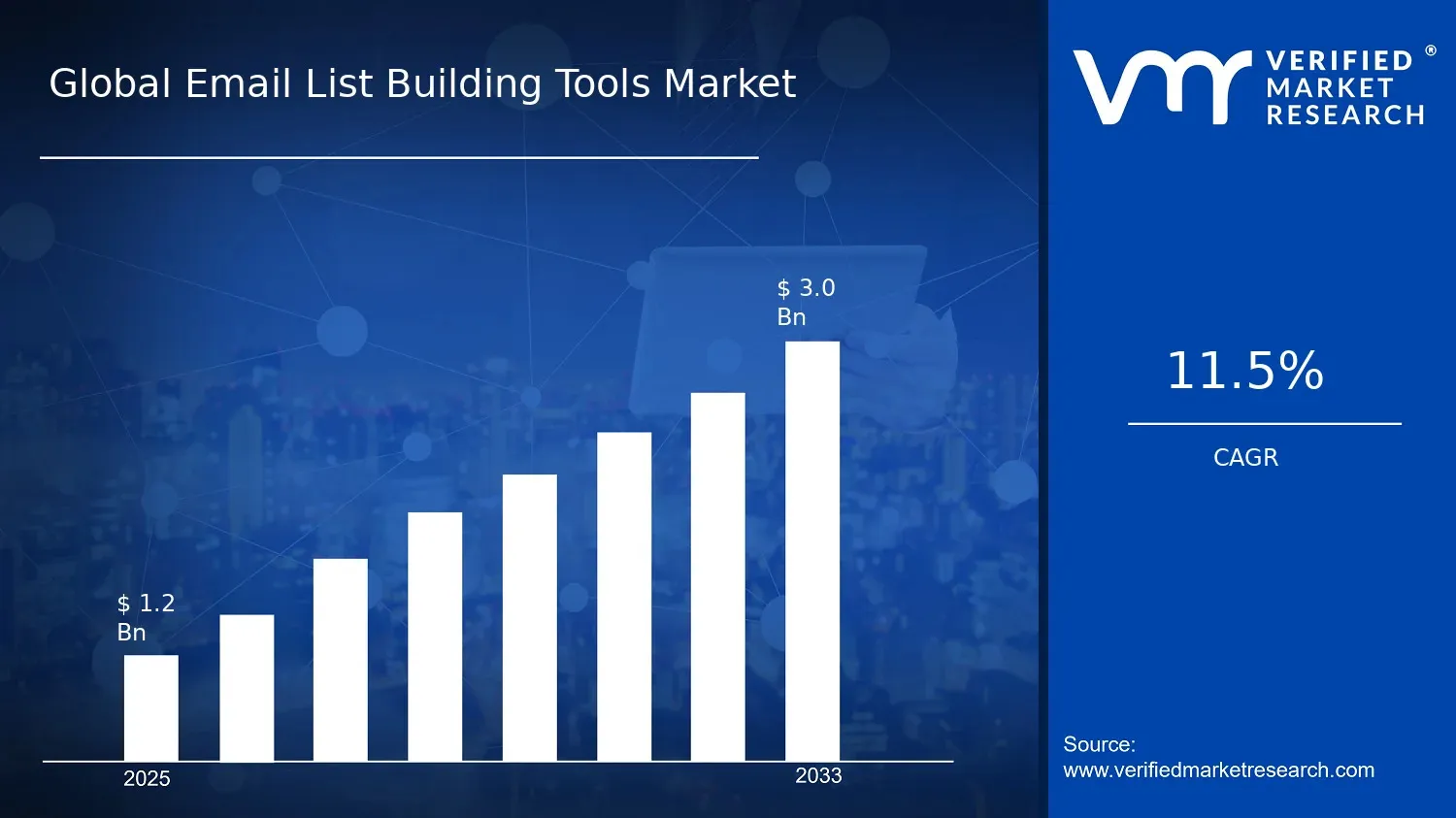
The Global Email List Building Tools Market was valued at $1.20 Bn in 2025 and is forecast to reach $3.00 Bn by 2033, according to Verified Market Research®. Demand is being shaped by accelerating digital lead generation, tighter email compliance expectations and broader adoption of automated verification workflows. A clear trend is under way as organizations shift from volume-based outreach to measurable conversion outcomes, positioning list building as an operational layer of the sales and marketing stack. The outlook through 2033 points to double-digit expansion across deployment models and end-user groups, led by an 11.5% CAGR.
LEWES, Delaware, Nov. 25, 2026 (GLOBE NEWSWIRE) -- The Global Email List Building Tools Market Size was valued at $1.20 Bn in 2025 and is forecast to reach $3.00 Bn by 2033, expanding at a compound annual growth rate (CAGR) of 11.5% over the 2025 to 2033 forecast period, according to analysis published by Verified Market Research®. The Email List Building Tools Market is advancing on the back of accelerating digital lead generation, tighter email compliance expectations and the growing adoption of automated verification workflows, a combination that Verified Market Research® expects to sustain double-digit expansion through 2033.
Download a free sample to access exclusive Insights, Data Charts, And Forecasts From Email List Building Tools Market Size Sample Report
The research indicates that demand for structured list acquisition and higher deliverability performance will remain the dominant trajectory for the Email List Building Tools Industry. As organizations move away from volume-based outreach and toward measurable conversion outcomes, email list building capabilities increasingly function as an operational layer inside sales and marketing stacks. Data-quality imperatives linked to fraud prevention and compliance enforcement are raising the value of verification and enrichment, and these forces are expected to support growth across deployment models and end-user groups alike.
The Email List Building Tools Market Size and Forecast Snapshot in the report describes expansion that is more than incremental. According to Verified Market Research®, the progression from the 2025 base year to the 2033 forecast value suggests that adoption is broadening across marketing and sales workflows, while tool capabilities are becoming embedded in routine go-to-market operations. For stakeholders assessing the Email List Building Tools Market, the combined effect points to a scaling phase in which demand is increasingly shaped by performance requirements such as list quality, deliverability risk management and faster lead discovery cycles.
Email List Building Tools Market Overview
What the Market Is
The Email List Building Tools Market is defined around software-enabled capabilities that help organizations and individuals discover, validate and operationalize email addresses for outbound and relationship-based communication. Participation is determined by the presence of tool-driven functionality that supports one or more core stages of email list construction: sourcing potential contacts, verifying deliverability and format validity, and structuring results into usable lists for downstream marketing, sales or outreach workflows. The market is distinct because its primary value is not generic customer data management, but the quality and usability of email identifiers for contactability, including mechanisms that reduce bounce risk and improve the practicality of lists for communication at scale.
Offerings are typically delivered as platforms or utilities that directly perform list construction tasks. The Global Email List Building Tools Market therefore includes three functional categories:
- Email verification tools, which validate whether an address is deliverable and properly formatted.
- Lead generation tools, which capture or produce candidate leads that include email as a target attribute.
- Email finder tools, which locate email addresses associated with known entities such as companies, individuals or web domains.
Scope also reflects how these capabilities are deployed. Cloud-based solutions run as managed services, while on-premise software operates within an organization's controlled environment. Deployment is treated as a structural category because it changes governance, data handling expectations and the way list-building outputs are managed and audited.
Why the Market Matters
Verified Market Research® positions the Email List Building Tools Industry within the broader communications and lead generation ecosystem as the capability layer that enables the creation and readiness of email lists for downstream outreach, rather than as the outreach execution layer itself. Its commercial relevance stems from a direct link between acquisition goals and the operational need for trustworthy contact data. As firms pursue measurable pipeline targets, list building is increasingly tied to conversion metrics, making email verification and validation a prerequisite for campaign effectiveness rather than a discretionary add-on.
Scope Boundaries: What Is Excluded
Boundary setting is essential, because several adjacent categories can resemble email list building at a high level while differing in technology and value chain position. The report excludes the following:
- Generic customer relationship management (CRM) platforms whose primary function is pipeline, contact management and sales execution. CRM systems may store email data, but they do not inherently provide specialized mechanisms such as verification logic or address discovery.
- Marketing automation suites that mainly orchestrate campaigns, segmentation and channel delivery. Such systems may consume validated lists but sit downstream of list formation.
- Data brokerage and legacy data enrichment services where the main product is bulk data supply rather than tool-based verification, discovery and continuous list-building operations.
Geographically, the Email List Building Tools Market is assessed across regions using a country and regional lens consistent with global market sizing conventions, without expanding into adjacent categories such as pure campaign orchestration, standalone CRM contact management or non-tool data supply.
Download a free sample to access exclusive Insights, Data Charts, And Forecasts From Email List Building Tools Market Size Sample Report
Email List Building Tools Market Growth Drivers
The expansion of the Email List Building Tools Market is explained primarily by a cause-and-effect link between commercial acquisition goals and the operational need for trustworthy contact data. Verified Market Research® identifies several reinforcing drivers that together support the Email List Building Tools Market growth forecast through 2033.
Stricter Deliverability Requirements
Sales and marketing teams face tighter deliverability expectations, where invalid, risky or inactive addresses degrade sender reputation and reduce conversion rates. Email service providers increasingly filter low-quality or risky lists, which raises the cost of poor data and strengthens the business case for ongoing verification and list hygiene. This directly increases the need for email verification tools and email finder tools to validate contact quality before sends and to expand lists responsibly. As these workflows become embedded in campaign and CRM processes, purchases shift from one-off enrichment to recurring tool usage, expanding the addressable Email List Building Tools Market. Businesses also increasingly work with email deliverability consultants to identify sending issues, improve sender reputation and ensure that verification and list-building processes support long-term inbox placement.
Privacy and Consent Compliance Pressure
Regulatory expectations around personal data processing continue to tighten. The report points to the GDPR framework established by the European Union, which requires lawful processing and accuracy-related diligence and shapes how marketers source and maintain email contacts (source: European Commission). Consent requirements and data protection expectations raise the operational cost of maintaining outreach lists, because organizations must minimize inaccurate data and improve traceability. Verification and controlled list-building flows reduce bounce-driven risk and support internal review processes, which becomes more valuable as compliance scrutiny increases. The result is more frequent procurement and a preference for tools that fit policy-driven workflows.
AI-Assisted Prospecting and Automation
As outreach teams automate prospect research and campaign execution, manual lead sourcing cannot keep pace with pipeline targets. Lead generation tools and email finder tools increasingly power automated enrichment and segmentation, creating a feedback loop in which larger, faster list creation improves targeting and performance metrics. That performance incentive leads to higher run-rate usage: subscriptions are renewed and expanded because each campaign iteration depends on continuously updated contacts.
A Shift from Static Purchases to Continuous Cycles
Industry behavior reflects a move from static list purchases toward tools that support continuous acquisition and cleaning cycles, especially for lead generation. Over time, this strengthens recurring usage patterns for cloud-based systems and creates selective demand for on-premise verification in highly controlled environments.
Ecosystem Drivers
The industry ecosystem is evolving toward standardized integration between prospecting, verification and CRM or marketing automation stacks. As infrastructure for data processing, scoring and real-time validation matures, suppliers can offer lower-latency enrichment and more reliable outputs. Capacity expansion through cloud infrastructure and selective consolidation among specialized vendors reduces implementation friction, enabling faster deployment of solutions in both cloud-based and on-premise environments.
How the 11.5% CAGR Should Be Interpreted
An 11.5% CAGR implies that growth is sustained by multiple reinforcement loops rather than a single driver. Volume expansion is expected as more organizations formalize acquisition functions and increase the cadence of prospecting campaigns, which raises the need for list assembly, enrichment, validation and ongoing hygiene. Buyers are also changing how they evaluate outcomes, treating list building as continuous infrastructure that protects sender reputation and reduces wasted outreach instead of a one-time activity. Finally, new adoption patterns and pricing shifts matter where buyers move from manual verification and ad hoc scraping toward standardized toolchains that lower operational effort and improve data confidence. Maturity pressures are expected to emerge only in subsections that face commoditization and tighter differentiation.
Segment-Linked Drivers
Adoption intensity varies because deliverability risk, governance needs and automation readiness differ by buyer type and tool category.
- Small and Medium Enterprises (SMEs): operational deliverability is the dominant driver. Limited staff capacity pushes SMEs to outsource validation and list discovery, favoring email verification and email finder tools that can be activated quickly. As campaign volume grows, usage shifts from occasional cleanup to recurring enrichment.
- Large Enterprises: governance and auditability dominate. Compliance teams require repeatable controls over contact quality and processing, producing longer-cycle but higher-value procurement and a preference for deployment models aligned with internal policy.
- Freelancers and Individuals: automation speed is the main driver. Budget and time constraints favor streamlined lead generation and email finder tools, with subscription uptake rising during active campaign periods.
- Email verification tools: deliverability protection drives demand, as verified outputs directly reduce bounces and reputation risk.
- Lead generation tools: pipeline automation drives demand as organizations scale campaigns and require recurring prospect acquisition.
- Email finder tools: structured prospect discovery drives demand where finding usable contacts is the bottleneck for outreach scale.
- Cloud-based deployment: rapid scalability enables higher-volume enrichment during campaign surges.
- On-premise deployment: data control and local processing support internal security and governance requirements.
Emerging Opportunities in the Email List Building Tools Industry
Verified Market Research® identifies several opportunity clusters in which value can be captured by aligning product capabilities to measurable risk reduction and measurable output gains. In 2025, opportunities cluster around operational outcomes such as deliverability, data quality and conversion efficiency, because list building directly influences revenue attribution and sales execution.
- Compliance-aware verification and consent intelligence: as inbox providers tighten filtering and regulators raise scrutiny, organizations seek list quality systems that validate address existence without ignoring consent signals. Treating verification as a governance layer rather than a utility feature creates a timing advantage, supported by audit-ready workflows, modular verification tiers, automated re-verification schedules, bounce feedback ingestion and deduplication orchestration.
- AI-assisted email discovery and enrichment: the market is moving from manual finding to repeatable discovery, yet adoption remains uneven because of inconsistent source coverage and weak entity resolution across domains. By connecting discovery outputs to verification steps, vendors can close the accuracy gap and shorten time-to-prospect.
- SME cloud adoption: SMEs often underuse list building because deployments are perceived as complex and procurement cycles are slow. Cloud-based offerings with low-friction, pay-as-you-go licensing can address this by reducing integration effort and enabling usage-based scaling tied to campaigns.
- Lead generation enrichment bundles: bundling that bridges acquisition and actionability, through unified scoring and enrichment expansion across company, role and contact context, can convert feature adoption into sustained seats.
- Provenance-aware email finder capabilities: quality gates such as confidence scoring, throttled output with verification checkpoints and transparent match logic can become a defensible advantage as users expect fewer empty or risky results.
- Cloud-to-on-premise hybrid architectures: standardized APIs across cloud-based and on-premise modes, with consistent core verification logic, can serve buyers who split workloads between fast execution and controlled environments.
- Automation for deduplication, segmentation and continuous list maintenance: because list building becomes valuable when it is maintained and not only created, scheduled verification and maintenance dashboards can turn operational outputs into measurable performance signals.
At the ecosystem level, convergence of verification outputs, field schemas and export formats could allow CRM and marketing automation ecosystems to onboard list building faster. Infrastructure investment in scalable data ingestion and identity matching may also lower per-contact processing costs, attracting new entrants and partnerships.
Opportunity concentration is structurally strongest in large enterprises, where governance, reporting and integration requirements drive demand for higher-assurance solutions and support premium pricing and larger contract sizes. SMEs tend to prioritize lead generation and email finder workflows that reduce manual work, provided onboarding is simple and return on investment is clear. Freelancers and individuals represent an emerging but sensitive profile in which affordability and speed make frictionless cloud-based experiences attractive. Overall, saturation tends to be higher in basic list-building features, while differentiators emerge in integrated quality gates and automated maintenance.
Download a free sample to access exclusive Insights, Data Charts, And Forecasts From Email List Building Tools Market Size Sample Report
Market Challenges and Restraints
Despite a favorable outlook, the Email List Building Tools Market Growth trajectory faces barriers that vary across tool types, deployments and buyer groups.
Compliance Scrutiny and Legal Uncertainty
Privacy and consent expectations vary across jurisdictions and list sources. Verification and enrichment activities can be interpreted as processing personal data, triggering documentation, audit and retention requirements. This increases procurement friction for end users, slows partner onboarding for vendors and raises the cost of maintaining compliant workflows across both cloud and on-premise deployments.
Operating Costs and Margin Pressure
Achieving stable bounce-rate reduction requires ongoing verification, refresh cycles and reputation monitoring, which increases labor and compute expenses. As a result, pricing pressure intensifies for lead generation and email finder tools, delaying larger contract renewals and making customers cautious about scaling list volume beyond initial pilots. Smaller buyers feel this compression most.
Performance Variability and Infrastructure Limits
The market relies on continuously updated datasets, parsing and validation models, but output quality can fluctuate with data source volatility, anti-scraping defenses and network throttling. When verification and finder accuracy dips, downstream campaign performance falls and buyers lose confidence in repeatability. This drives churn risk, extends evaluation cycles and limits scalability across geographies and deployment environments.
Ecosystem Constraints
Supply-side bottlenecks emerge when data availability changes faster than model refresh schedules, creating inconsistent list coverage. Fragmentation and limited standardization across sources and verification schemas make it harder for vendors to guarantee uniform accuracy, while capacity constraints in data pipelines and geographic or regulatory inconsistencies amplify compliance cost and operational risk. Together these issues increase buyer uncertainty and reduce the elasticity of spend through 2033.
Segment-Linked Constraints
- SMEs: constrained by operating cost pressure and deliverability uncertainty, with fewer campaigns and less internal capacity to test, verify and monitor performance at scale.
- Large Enterprises: constrained by compliance and governance intensity, including internal risk reviews and alignment with security controls, which lengthen procurement cycles.
- Freelancers and Individuals: constrained by cost-to-value sensitivity and tool complexity, often lacking dedicated deliverability management.
- Email verification tools: sustained accuracy and monitoring across changing sender and domain behaviors raise total cost of ownership.
- Lead generation tools: compliance-linked uncertainty and data sourcing variability reduce confidence in scale.
- Email finder tools: accuracy can drop when source restrictions or anti-scraping countermeasures apply, shifting verification burden to buyers.
- Cloud-based deployments: integration governance and data handling controls can delay onboarding.
- On-premise deployments: maintenance burden and operational capacity can limit scalability across geographies.
Technology and Innovation Trends
Technology in the Email List Building Tools Industry determines how effectively organizations identify targets, validate contact quality and keep outreach programs operational and compliant. Verified Market Research® describes innovation along two tracks: incremental improvements that reduce friction in verification and email discovery workflows, and more transformative changes that reshape how data is assembled, refreshed and acted upon at scale.
Core Technology Landscape
The foundation of the market is systems that transform raw identity signals into usable email targets and then maintain confidence in those targets over time. Verification capabilities apply rule-based and behavioral checks that can be executed quickly within list-building pipelines. Email finder tools function as information retrieval and enrichment workflows, normalizing contact cues into structured outputs that sales and marketing systems can consume. Lead generation tools act as orchestration layers that coordinate list creation, segmentation logic and export activities, so that list building becomes a repeatable process rather than a manual task.
Key Innovation Areas
- Verification designed for lifecycle accuracy: rather than a static gate, verification logic increasingly reflects how inbox availability and address validity change over time, reducing the mismatch between addresses that are valid on export and those that are deliverable during outreach.
- Enrichment workflows that standardize identity data: improved normalization and matching logic helps address data heterogeneity, producing outputs that integrate cleanly with CRM and marketing databases and require fewer manual corrections.
- Deployment-ready automation: automation patterns that can be packaged consistently across cloud and on-premise deployments reduce operational overhead for recurring list builds, supporting speed for freelancers and SMEs and controlled workflows for large enterprises.
Structural Market Trends
- Convergence of verification, discovery and enrichment into unified workflows: functions once purchased separately are bundled around stages of the list lifecycle, so vendors are judged on end-to-end list consistency across repeated runs.
- Cloud deployment as the default operating model: cloud platforms support ongoing execution, scheduled verification and repeated contact screening, with competition intensifying around reliability, auditability and workflow stability.
- Compliance-oriented list hygiene routines: success is defined less by finding more contacts and more by maintaining usable lists over time, which reshapes procurement criteria.
- A split-then-re-merge pattern: vendors deepen specialization within tool categories while buyers push toward integrated solutions that combine specialized performance with workflow-level integration.
- Standardized governance practices: segmentation by deployment becomes less about cloud versus on-premise alone and more about operational fit, including who can manage settings and review outputs.
Value Chain, Production and Trade Dynamics
The Email List Building Tools Market is shaped less by physical manufacturing and more by the operational production of software capabilities and data-driven workflows. Production is generally concentrated in technology ecosystems with specialized expertise in email validation, list hygiene rules and integration engineering, and capacity constraints tend to emerge from platform throughput and risk-control operations. Across the value chain, upstream participants provide data inputs and technical building blocks, midstream layers transform them into verified, segmented and deployable lists, and downstream end users convert those lists into campaigns, outreach systems and CRM-driven sales motions. Value capture is typically concentrated in the layers that own verification logic, workflow orchestration and integration patterns, since these determine switching costs and long-term usability.
Trade patterns appear as cross-region licensing, API access and implementation support rather than physical shipments. The report characterizes the market as regionally regulated and operationally global, with onboarding and enforcement often following the pace of local governance rather than the speed of technical delivery.
Regulatory and Policy Environment
Verified Market Research® characterizes the regulatory environment as moderate-to-high intensity, with obligations emerging primarily around data protection, lawful processing and communication permissions rather than industrial safety or production licensing. Policy acts as a dual force: it can enable expansion by clarifying acceptable use patterns, while also constraining operations through enforcement risk, documentation requirements and cross-border compliance complexity.
To participate effectively, vendors typically need consent- and legitimacy-aware processing, documented data lineage and traceable verification and enrichment workflows. The report links this burden to higher diligence and assurance expectations in commercial procurement, testing needs for data quality controls and longer sales cycles where enterprise buyers require governance evidence. These requirements raise barriers to entry for smaller firms and favor vendors with stronger audit artifacts. Regions with clearer consent and data handling expectations tend to show more predictable adoption and lower procurement friction, whereas fragmented policy interpretations raise implementation variability and compliance cost.
Investment and Funding Landscape
The report notes limited public evidence of new capital rounds, mergers and acquisitions or large-scale funding announcements over the past 12 to 24 months. Investor confidence appears to be expressed through sustained research and development and platform iteration rather than highly visible consolidation. The absence of prominent deal signals, according to Verified Market Research®, does not indicate stagnation; it suggests that funding is being expressed through iterative capability upgrades.
- Real-time and multi-layer email verification remains a dominant capital allocation theme. Platforms such as Anymail Finder and Icypeas emphasize real-time verification, while ListKit highlights a triple-verification process.
- Infrastructure and automation for scalable lead sourcing reflect ongoing investment in layers that connect email discovery, enrichment and validation into fewer operational steps.
- Deployment-aligned engineering supports cloud-based workflows for speed and on-premise options for control.
- Segment-specific value delivery balances lightweight tooling for SMEs against the higher assurance and workflow integration needs of large enterprises.
Industry Use Cases and End Users
The Email List Building Tools Market manifests as an operational workflow rather than a single software task. Organizations apply these capabilities to pipeline development, outbound marketing execution, partner outreach and research workflows in which contact accuracy directly affects deliverability and conversion.
End-User Segments
- Small and Medium Enterprises: typically require streamlined workflows, lower operational overhead and repeatable lead acquisition cycles, and often drive volume growth through faster experimentation, using email finder and lead generation tools to widen top-of-funnel coverage while verification mitigates deliverability risk.
- Large Enterprises: concentrate spend on governed, compliance-aware data practices and integrate list building into broader demand generation and CRM governance, favoring robust verification and higher-throughput lead generation.
- Freelancers and Individuals: align with lighter-weight deployments and narrower use cases, measuring effectiveness by time efficiency and immediate campaign readiness, which results in steadier but more bounded usage intensity.
Core Application Scenarios
- Pre-send sanitization: email verification tools remove invalid, risky or unreachable addresses to protect sending reputation, often as a control step run close to campaign execution or import cycles.
- Continuous pipeline creation: lead generation tools source and structure leads for downstream outreach, frequently tied to ongoing pipeline programs.
- Contact completion: email finder tools bridge the gap between a known prospect and a usable contact record when only partial identity data is available, typically around targeted prospecting or account research.
High-Impact Use Cases
Demand generation teams building outbound targets from fragmented prospect data often start with firmographic or behavioral signals that identify companies or roles but lack usable email addresses. Email finder tools fill the missing field, enabling enriched segments for outreach sequences, whether launching new industry campaigns, refreshing legacy targeting lists or expanding accounts. The need to qualify and standardize results sustains demand for verification and list building orchestration.
CRM and marketing automation operations use email verification tools before contacts are activated in outbound channels, reducing bounce rates and reputation risk. Verification is triggered during data ingestion, scheduled re-checks or pre-send validation, so consumption follows each import cycle and campaign schedule rather than a one-time setup.
Freelancers and independent consultants generating prospect lists for client onboarding treat list building as a time-bounded delivery task tied to proposals or short-cycle outreach. Operational speed is the priority: compiling contactable records, verifying them enough for safe outreach and producing structured lists that can be handed off to a client's tools. This makes cloud-based access especially relevant.
Download a free sample to access exclusive Insights, Data Charts, And Forecasts From Email List Building Tools Market Size Sample Report
Regional Outlook for the Global Email List Building Tools Market
The Email List Building Tools Market behaves unevenly across geographies because of differences in digital marketing maturity, data-governance expectations and the operational need for compliant contact accuracy. The report covers five regions.
North America
North America is characterized by high operationalization of outbound growth processes, in which email verification and email finder workflows are embedded into CRM and marketing automation stacks. A dense concentration of B2B services, SaaS and digital commerce firms relies on repeatable pipeline generation rather than ad hoc list sourcing. Key factors include:
- Enterprise density and repeatable pipeline economics, which reward tools that standardize lead discovery and maintain list hygiene.
- Strict enforcement expectations for data governance, which raise the value of verification and the transparency of lead generation and email finder tools.
- Cloud integration depth across marketing and CRM stacks, favoring rapid onboarding and API-based syncing.
- Capital availability for automation and data quality initiatives, supporting uptake of enrichment and list validation programs.
- Infrastructure maturity enabling higher-throughput validation and outreach preparation.
Europe
Europe shapes the Email List Building Tools Industry through a regulation-led, quality-first operating model. Verified Market Research® analysis indicates that EU-level privacy governance and harmonized data-handling expectations push organizations toward workflows that emphasize consent documentation, transparent sourcing and ongoing validity checks. In 2025, buyers prioritize outputs that can withstand audits and internal governance reviews, especially email verification and email finder tools. Key factors include:
- EU privacy governance and harmonized compliance constraints, which favor evidence-oriented workflows and minimize uncertainty in list provenance.
- Data minimization and quality expectations, which keep lists lean and make verification a frequent procurement priority.
- Cross-border market integration, which drives demand for centrally governed deployment models, including cloud-based controls where data residency can be managed contractually.
- Sustainability and responsible marketing efficiency pressures, which connect list quality to operational efficiency and early suppression of invalid contacts.
- Regulated innovation and enterprise-grade validation needs, including logging, role-based access and reproducible outcomes.
Asia Pacific
Asia Pacific is a high-growth, expansion-driven region shaped by contrasting development paths. More mature digital ecosystems in Japan and Australia favor workflow-integrated adoption and stronger compliance expectations, while India and parts of Southeast Asia typically expand through fast-growing end-use industries and lower-cost experimentation. Rapid industrialization, urbanization and population scale increase lead capture opportunities, raising the need for verification, finder and lead generation capabilities. Key factors include:
- Industrial expansion and manufacturing-driven lead flows that increase B2B prospecting volume.
- Population scale and diverse customer acquisition channels that broaden contact data sources and the need to validate them.
- Cost competitiveness in tool adoption, tilting buyers toward scalable, automation-friendly configurations.
- Urban infrastructure and faster digital operationalization, accelerating campaign activity and data refresh cycles.
- Uneven regulatory expectations across countries, which affect how aggressively organizations pursue list expansion.
- Rising investment and government-led digital initiatives that bring SMEs and mid-market teams into the market.
Latin America
Latin America remains at an emerging stage, with adoption expanding gradually rather than uniformly. Demand is concentrated in key economies such as Brazil, Mexico and Argentina, where digital commerce, lead generation spend and data-driven sales motions are maturing. Growth is closely tied to economic cycles, and the region tends to be more sensitive to cost and onboarding complexity. Key factors include:
- Currency-driven budget instability affecting SMBs and freelancers in particular.
- Uneven industrial development across countries, with staged adoption that often starts with basic email finder or lead generation functions before moving to stronger verification.
- Dependence on import-linked supply chains, which can introduce procurement friction and push adoption toward cloud-based offerings.
- Infrastructure and logistics limitations that affect verification performance and the feasibility of on-premise maintenance.
- Regulatory variability and policy inconsistency, creating compliance-driven demand alongside cautious purchasing.
- Gradual foreign investment and market penetration, beginning with larger enterprises and extending to SMEs and freelancers.
Middle East & Africa
Verified Market Research® views the Middle East & Africa as a selectively developing region rather than a uniformly expanding one. Demand is shaped primarily by Gulf economies, where digitization and diversification programs concentrate budgets into governed initiatives, while South Africa and several fast-growing urban centers act as demand anchors for business-to-business lead workflows. Key factors include:
- Gulf policy-led digitization that concentrates budgets and supports adoption where procurement and compliance requirements are clear.
- Sharp variation in infrastructure and industrial readiness across African markets.
- Import dependence, which shapes availability and total cost and can raise on-premise interest where data residency matters.
- Urban and institutional centers, such as financial services, telecom-adjacent ventures and large distributors, driving early demand formation.
- Regulatory inconsistency, which changes adoption timelines and leads multi-country sellers to stage adoption cautiously.
- Gradual public-sector and strategic projects that build downstream demand over a longer ramp.
Download a free sample to access exclusive Insights, Data Charts, And Forecasts From Email List Building Tools Market Size Sample Report
Competitive Landscape
The competitive landscape of the Email List Building Tools Industry is fragmented across tool types and customer sizes, with few firms covering the full workflow end to end while many specialize in one capability such as email verification, email finding, enrichment or lead-triggered prospecting. Competition is shaped less by broad brand awareness and more by measurable outcomes: contact data accuracy, deliverability impact, compliance readiness and the speed at which users move from account discovery to outreach lists. Global platforms compete through scale in coverage and automation, while specialists compete through tighter performance in specific datasets, faster search workflows or integrations. Competitive intensity is expected to rise toward 2033 as buyers demand higher reliability, clearer governance controls and lower operational friction.
Company Profiles
- ZoomInfo Technologies: an integrated data and prospecting platform supplier combining structured business intelligence with list building and outbound targeting workflows. Its breadth of coverage and links between account-level discovery and contact-level action set expectations for data completeness and integration, increase the performance bar for verification and finder tools, and shift large enterprise buyers toward bundle-based evaluations.
- Clearout: positioned as an AI-powered email finding and data quality specialist serving over 80,000 businesses worldwide with 99.73% email verification accuracy. It combines discovery with real-time verification, instant and bulk finding, API workflows, LinkedIn Email Finder and in-app prospecting. Differentiators include Deep Verify, which resolves difficult catch-all emails as valid or invalid, Form Guard for point-of-submission validation and Data Pulse for continuous CRM verification and enrichment.
- Hunter.io: a specialist-to-systems player focused on email finding and verification-style workflows that speed list assembly. It competes on turnaround speed, result relevance and verification usability for teams that do not want complex data pipelines, pushing vendors toward tighter loops between discovery and validation.
- Snov.io: an execution-focused platform for sales teams that treats list construction as a repeatable process, with discovery, validation and outreach preparation in one interface. Its multi-tool value in a single subscription influences pricing and bundling strategies and can reduce switching costs.
- Clearbit: plays an enrichment and targeting enablement role that extends list building beyond retrieval, emphasizing enrichment, segmentation inputs and downstream personalization. It raises the bar for fit-for-purpose data, shifting demand from raw volume toward higher-quality lists.
- Lusha: a contact data access and list building specialist oriented toward speed and team adoption, simplifying contact acquisition for smaller teams without dedicated data engineering resources and setting benchmark expectations for time to usable list.
Beyond these six, the report names a broader competitive set that contributes to the market's layered structure:
- VoilaNorbert, AeroLeads, Leadfeeder, Skrapp and UpLead
- LeadGibbon, Prospect.io, Adapt.io, FindThatLead and GetProspect
- Anymail Finder, Icypeas and ListKit, cited in the investment analysis for their emphasis on real-time or multi-layer verification
Several of these operate as niche specialists aligned with a particular tool type, while others provide broader enrichment or lead-triggering support. Regional and channel-driven participants typically compete on practical coverage for freelancers and SMEs that prioritize affordability and straightforward list building. Verified Market Research® expects competition to evolve in two parallel directions: consolidation through workflow bundling for buyers seeking operational simplicity, and continued diversification in which specialists remain valuable for verification reliability or dataset coverage.
Download a free sample to access exclusive Insights, Data Charts, And Forecasts From Email List Building Tools Market Size Sample Report
Email List Building Tools Market Segmentation
The report treats segmentation as a structural lens: end-user needs explain why organizations adopt, tool type clarifies what they use, and deployment determines how value is operationalized. The Email List Building Tools Market is segmented as follows:
By Tool Type
- Email Verification Tools
- Lead Generation Tools
- Email Finder Tools
By Deployment
- Cloud-Based
- On-Premise
By End User
- Small and Medium Enterprises
- Large Enterprises
- Freelancers and Individuals
By Geography
- North America
- Europe
- Asia Pacific
- Latin America
- Middle East & Africa
Growth is expected to concentrate where buyers prioritize faster prospect discovery with fewer list hygiene failures, while segments anchored in occasional use or manual alternatives tend to show slower relative momentum as more buyers standardize around integrated tool workflows.
Strategic Outlook Through 2033
The Email List Building Tools Market Forecast to 2033 describes an industry moving from standalone utilities toward integrated toolchains that align verification, lead discovery and list hygiene into repeatable processes. With the Email List Building Tools Market Size rising from $1.20 Bn in 2025 to $3.00 Bn in 2033 at an 11.5% CAGR, Verified Market Research® expects tooling to become a default component of sales and marketing stacks.
For stakeholders, the report advises that growth is less about universal feature adoption and more about aligning product capabilities with the funnel stage, the buyer's risk profile and the implementation environment. Opportunities are likely to emerge in improving deliverability confidence for high-volume buyers, shortening time-to-contact for independent users and tailoring deployment and governance features for regulated enterprise contexts. Scale-oriented investments usually align with verification and maintenance automation, because repeat usage and measurable risk reduction support durable unit economics. Innovation-heavy paths, such as provenance-aware finder logic and enrichment bundles, can generate differentiation but require careful quality control.
Short-term wins often come from cloud-based workflow simplification and bundled activation, while long-term value typically favors hybrid architectures and audit-ready reporting that reduce enterprise adoption friction. The most resilient strategies balance innovation with cost discipline and phase deployment depth so that capabilities mature alongside buyer governance needs. Across the Global Email List Building Tools Market, competition is likely to tighten around measurable deliverability outcomes and governance readiness rather than feature count alone.
Related Reports
Global Email Archiving Software Market Size By Type (Cloud Based, On Premise), By Application (Enterprise, School, Banks), By Geographic Scope And Forecast
Global Mobile Marketing Market Size By Component (Platform, Service), By Channel (Messaging, Push notification, Mobile Emails, Quick Response (QR) Code, Location based Marketing, In app Messages, Mobile Web), By End User (Retail and E commerce, Travel and Logistics, Automotive, BFSI, Telecom and IT), By Organization Size (Small & Medium Enterprises, Large Enterprises), By Geographic Scope And Forecast
Global Email Security Market Size By Security Type (Hybrid Email Encryption, Gateway Email Encryption), By Component (Products, Services), By End-User Industry (Healthcare, Government), By Geographic Scope And Forecast
Global Email Encryption Market Size By Component (Solutions, Services), By Encryption Type (End-to-End Encryption, Gateway Encryption), By Deployment Type (On-Premise, Cloud-Based), By Geographic Scope and Forecast
Top 7 Email Marketing Software bringing automation capabilities for businesses
Visualize Email List Building Tools Market using Verified Market Intelligence -:
Verified Market Intelligence is our BI Enabled Platform for narrative storytelling in this market. VMI offers in-depth forecasted trends and accurate Insights on over 20,000+ emerging & niche markets, helping you make critical revenue-impacting decisions for a brilliant future.
VMI provides a holistic overview and global competitive landscape with respect to Region, Country, Segment, and Key players of your market. Present your Market Report & findings with an inbuilt presentation feature saving over 70% of your time and resources for Investor, Sales & Marketing, R&D, and Product Development pitches. VMI enables data delivery In Excel and Interactive PDF formats with over 15+ Key Market Indicators for your market.
About Us
Verified Market Research® stands at the forefront as a global leader in Research and Consulting, offering unparalleled analytical research solutions that empower organizations with the insights needed for critical business decisions. Celebrating 10+ years of service, VMR has been instrumental in providing founders and companies with precise, up-to-date research data.
With a team of 500+ Analysts and subject matter experts, VMR leverages internationally recognized research methodologies for data collection and analyses, covering over 15,000 high impact and niche markets. This robust team ensures data integrity and offers insights that are both informative and actionable, tailored to the strategic needs of businesses across various industries.
VMR's domain expertise is recognized across 14 key industries, including Semiconductor & Electronics, Healthcare & Pharmaceuticals, Energy, Technology, Automobiles, Defense, Mining, Manufacturing, Retail, and Agriculture & Food. In-depth market analysis cover over 52 countries, with advanced data collection methods and sophisticated research techniques being utilized. This approach allows for actionable insights to be furnished by seasoned analysts, equipping clients with the essential knowledge necessary for critical revenue decisions across these varied and vital industries.
Verified Market Research® is also a member of ESOMAR, an organization renowned for setting the benchmark in ethical and professional standards in market research. This affiliation highlights VMR's dedication to conducting research with integrity and reliability, ensuring that the insights offered are not only valuable but also ethically sourced and respected worldwide.
CONTACT: Mr. Edwyne Fernandes

Verified Market Research®

US: +1 (650)-781-4080

US Toll Free: +1 (800)-782-1768

Email: sales@verifiedmarketresearch.com

Web: https://www.verifiedmarketresearch.com/

SOURCE – Verified Market Research®





Comments (0)
Login to join the conversation
Login / RegisterNo comments yet. Be the first to comment!