
Global market projected to expand from USD 8.94 billion in 2025 to USD 10.44 billion in 2026, registering an 18.1% CAGR through 2035
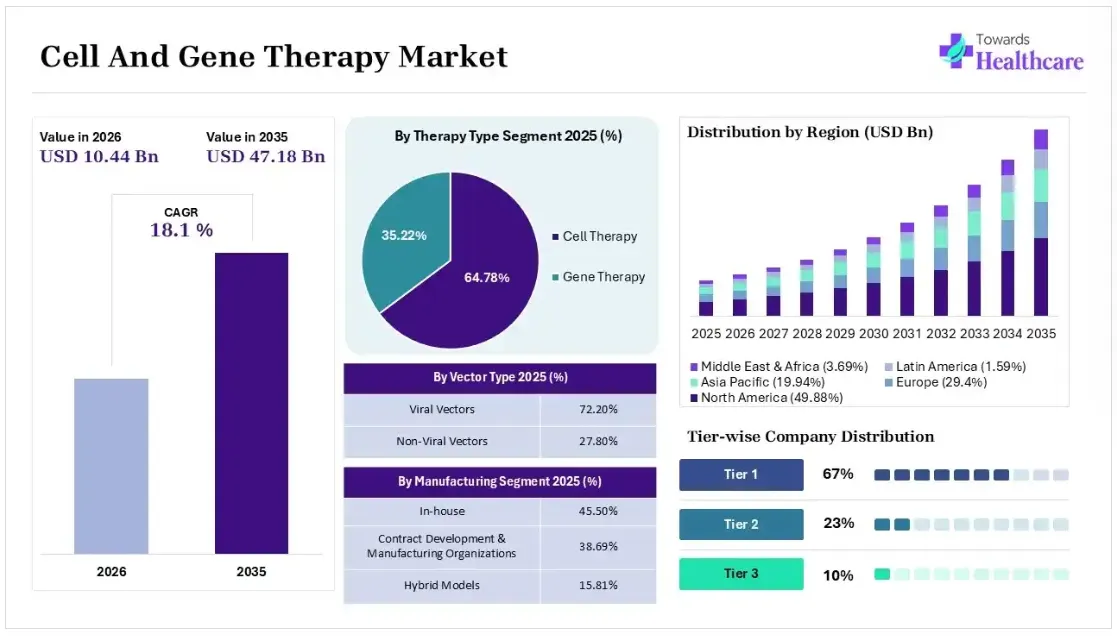
Ottawa, Nov. 03, 2026 (GLOBE NEWSWIRE) -- The global cell and gene therapy market is projected to increase from USD 8.94 billion in 2025 to USD 10.44 billion in 2026, reaching approximately USD 47.18 billion by 2035 at a compound annual growth rate (CAGR) of 18.1% from 2026 to 2035, according to Towards Healthcare Research & Consulting a sister firm of Precedence Research.
Request a complimentary sample of the market report, including its scope and research coverage @ https://www.towardshealthcare.com/download-sample/5052
The market is moving from clinical innovation toward broader commercialization. Expanding CAR-T applications, gene-editing platforms, viral and non-viral delivery technologies, and investment in specialized manufacturing are creating new opportunities across biotechnology, pharmaceutical development, contract manufacturing and healthcare delivery.
| Market indicator | Value | |
| Market size, 2025 | USD 8.94 billion | |
| Estimated market size, 2026 | USD 10.44 billion | |
| Forecast market size, 2035 | USD 47.18 billion | |
| CAGR, 2026–2035 | 18.1 | % |
| Leading therapy type, 2025 | Cell therapy, 64.78% | |
| Leading therapeutic area, 2025 | Oncology, 39.48% | |
| Leading region, 2025 | North America, 49.88% | |
Market Definition
Cell and gene therapies are advanced therapeutic approaches that use living cells or genetic material to prevent, manage or potentially treat diseases. Cell therapy involves introducing, modifying or administering cells to restore or improve biological functions. Gene therapy introduces, replaces or modifies genetic material to address the underlying causes of specific diseases.
The market covers cell therapy and gene therapy products, their delivery systems, manufacturing activities and end-use settings. It includes applications in oncology, genetic disorders, neurological conditions, cardiovascular diseases, ophthalmology, infectious diseases and other therapeutic areas. Manufacturing models include in-house production, contract development and manufacturing organizations (CDMOs), and hybrid arrangements.
Market Key Takeaways
- Cell therapy accounted for 64.78% of global market revenue in 2025, while gene therapy represented 35.22%.
- Oncology led therapeutic applications with a 39.48% share.
- Viral vectors held 72.20% of the vector-type market, reflecting established delivery platforms and commercial experience.
- In-house manufacturing represented 45.50%, while CDMOs accounted for 38.69%.
- Hospitals and specialty clinics represented 62.64% of end-use revenue.
- North America held 49.88% of global revenue; Asia Pacific accounted for 19.94% and is projected to grow fastest.
Market Trends
Commercial CAR-T therapies are broadening their reach. CAR-T products have established a commercial presence in hematological malignancies, while developers are investigating applications in solid tumors and autoimmune diseases. Research into allogeneic cell platforms, natural killer (NK) cells, tumor-infiltrating lymphocytes and T-cell receptor therapies is widening the competitive landscape.
Gene editing is moving toward more precise therapeutic applications. CRISPR-based approaches, base editing and other genome-modification technologies are supporting development programs for inherited disorders and other diseases. Non-viral delivery methods, including lipid nanoparticles and electroporation, are also attracting interest as developers seek alternatives to conventional viral-vector systems.
Manufacturing automation is becoming a commercial priority. Patient-specific production, complex quality testing and short product shelf lives create operational challenges. Closed-system processing, automated cell handling, digital manufacturing controls and advanced analytical methods are increasingly important for improving consistency and throughput.
Manufacturing partnerships are expanding across regions. Developers are combining specialist CDMO capabilities with in-house research and commercial operations. This model can provide access to GMP facilities, technical expertise and regional production networks without requiring every developer to build an entire manufacturing infrastructure independently.
Market Drivers, Restraints and Opportunities
| Market factor | Industry impact | Business significance |
| Rising prevalence of cancer and genetic disorders | Expands demand for advanced treatments | Supports pipeline investment and commercialization |
| Regulatory pathways and scientific progress | Can improve development efficiency | Creates opportunities for differentiated platforms |
| High treatment and manufacturing costs | Limits affordability and adoption | Increases demand for process efficiency and reimbursement strategies |
| Complex manufacturing and quality requirements | Creates capacity and consistency challenges | Supports CDMO, automation and testing demand |
| Emerging non-viral delivery and gene editing | Broadens technology options | Opens opportunities in platform development and licensing |
A major restraint remains the cost of treatment and delivery. Personalized production, specialized facilities, complex logistics and long-term patient monitoring can create substantial financial pressure for healthcare systems. Reimbursement models, treatment-center readiness and access to trained clinical teams will influence the pace of adoption.
Manufacturing scale-up, regional partnerships, process automation and more efficient delivery technologies represent important opportunities for companies seeking to improve commercial readiness.
Market Segmentations
By Therapy Type
| Segment | 2025 market share | Market position | Growth trend and business opportunity | |
| Cell therapy | 64.78 | % | Dominant | Established CAR-T and other cell-based treatments support current revenue. Allogeneic and next-generation immune-cell platforms create opportunities for broader production scale. |
| Gene therapy | 35.22 | % | Second-largest; fastest-growing | Gene replacement and editing programs are expanding across rare and inherited diseases, creating demand for vector technologies and specialized manufacturing. |
Cell therapy currently leads because of its established commercial presence and applications in oncology. Gene therapy offers substantial expansion potential as clinical programs progress and developers improve delivery, safety and manufacturing approaches.
By Indication / Therapeutic Area
| Segment | 2025 market share | Market position | Growth trend and business opportunity | |
| Oncology | 39.48 | % | Dominant | CAR-T and other engineered-cell approaches support demand, with opportunities in hematological cancers and emerging solid-tumor applications. |
| Genetic disorders | 12.05 | % | Fastest-growing identified segment | Gene replacement and editing programs are creating opportunities in rare diseases, including sickle cell disease and inherited conditions. |
| Other indications | 48.47%* | Combined remainder | Neurological, cardiovascular, ophthalmic, infectious, metabolic and musculoskeletal applications diversify the development pipeline. | |
Oncology remains the largest application because of the development and commercialization of engineered immune-cell treatments. Genetic disorders are an important growth area as gene-based approaches increasingly target the underlying causes of inherited conditions.
By Vector Type
| Segment | 2025 market share | Market position | Growth trend and business opportunity | |
| Viral vectors | 72.20 | % | Dominant | AAV and lentiviral platforms benefit from established clinical use and manufacturing experience. |
| Non-viral vectors | 27.80 | % | Emerging; faster-growing | Lipid nanoparticles and other delivery systems offer opportunities to improve scalability, flexibility and manufacturing economics. |
Viral vectors remain the established delivery category, while non-viral platforms are gaining attention as developers explore more flexible delivery approaches and ways to address vector production constraints.
By Manufacturing Type
| Segment | 2025 market share | Market position | Growth trend and business opportunity | |
| In-house | 45.50 | % | Largest segment | Provides process control, intellectual-property protection and direct oversight of proprietary manufacturing. |
| CDMOs | 38.69 | % | Second-largest; fastest-growing | Outsourcing supports access to GMP capacity, technical expertise, process development and commercial-scale production. |
| Hybrid models | 15.81%* | Flexible operating model | Combines internal control with external scale-up capabilities, helping developers manage capital and operational risk. | |
The expansion of CDMO partnerships reflects the specialized infrastructure required to manufacture advanced therapies. Hybrid models may also appeal to companies that want to retain control of critical development activities while outsourcing selected production or testing functions.
By End Use
| Segment | 2025 market share | Market position | Growth trend and business opportunity | |
| Hospitals and specialty clinics | 62.64 | % | Dominant | Treatment administration, specialist infrastructure and patient monitoring support the largest share. |
| Cancer treatment centers | 23.96 | % | Second-largest; faster-growing | Specialized oncology capabilities and cell-therapy administration support expansion. |
| Research institutes | 13.40%* | Supporting segment | Clinical research, translational development and early-stage treatment evaluation sustain demand. | |
Market Regional and Country-Level Analysis
North America accounted for 49.88% of global revenue in 2025, supported by established biotechnology companies, clinical research infrastructure, specialist treatment centers and a comparatively mature regulatory and commercialization ecosystem. The United States represented a major national market, estimated at USD 4.09 billion in 2025 and projected to approach USD 20 billion by 2035.
| Region / country | 2025 market position | Key development or trend | Business opportunity and strategic significance | |
| North America | 49.88 | % | Strong commercial presence, R&D investment and treatment infrastructure | Product commercialization, manufacturing investment, clinical networks and CDMO partnerships |
| United States | USD 4.09 billion market value | Large developer ecosystem and regulatory activity | Commercial manufacturing, gene-editing platforms and treatment-center expansion | |
| Europe | Approx. 24.94%* | Advanced therapy research and established regulatory framework | GMP manufacturing, cross-border clinical development and technology partnerships | |
| Asia Pacific | 19.94 | % | Fastest-growing regional market; 20.7% projected CAGR | Local manufacturing, clinical trials, technology transfer and regional market access |
| Middle East and Africa | 3.69 | % | Healthcare investment and emerging advanced-therapy infrastructure | Specialist treatment capacity, international partnerships and regional access |
| Latin America | Approx. 1.59%* | Developing commercialization and access environment | Distribution partnerships, clinical research and targeted market-entry strategies | |
Europe, the Middle East and Africa, and Latin America shares are calculated from the report's respective 2025 regional values against the USD 8.94 billion global market. Figures are rounded.
Asia Pacific is projected to increase from USD 1.78 billion in 2025 to USD 11.74 billion by 2035, representing a 20.7% CAGR. China, Japan, India, South Korea and Australia are important markets to monitor for clinical development, local production and regulatory progress. Europe is forecast to increase from USD 2.23 billion in 2025 to USD 11.83 billion by 2035.
Company and Competitive Intelligence
The competitive landscape includes established pharmaceutical companies, biotechnology developers, gene-editing specialists, cell-therapy innovators and CDMOs. Companies are differentiating through clinical pipelines, proprietary platforms, manufacturing capacity, strategic partnerships and commercialization capabilities.
Recent developments illustrate how investment and regulation are shaping the market:
- FDA potency assurance guidance, November 2, 2026: The U.S. Food and Drug Administration issued final guidance recommending a science- and risk-based potency assurance strategy across the product lifecycle. It addresses manufacturing process design, material controls, in-process testing and potency assays, including considerations for viral-vector and patient-specific therapies.
- Johnson & Johnson, February 2026: The company announced an investment of more than USD 1 billion in a next-generation cell therapy manufacturing facility in Montgomery County, Pennsylvania. The project is expected to support its advanced medicines pipeline and add more than 500 biomanufacturing jobs when fully operational.
- Eli Lilly, May 2026: Lilly opened its first dedicated genetic medicine manufacturing facility in Lebanon, Indiana, alongside an additional USD 4.5 billion investment across two Indiana manufacturing sites. The facility is intended to support genetic medicine development and production.
- AstraZeneca, March 2026: The company announced plans for a cell therapy manufacturing and supply facility in Shanghai, strengthening its capabilities for CAR-T programs and regional supply.
- Cellares, September 2026: The company announced collaborations involving automated manufacturing evaluation for gene-modified cell therapies, reflecting growing interest in industrialized and standardized cell-production platforms.
These developments highlight the importance of manufacturing readiness, quality assurance, regional supply networks and technology partnerships alongside clinical innovation. The FDA's latest guidance also reinforces potency testing as a lifecycle consideration rather than a final-stage release activity.
Emerging Business Opportunities
Several areas are positioned to attract commercial investment as the industry scales:
- Allogeneic cell therapies: Off-the-shelf production models may reduce dependence on individualized manufacturing and improve production planning.
- In vivo gene delivery: Delivery systems that enable genetic modification inside the body could create new therapeutic and manufacturing opportunities.
- Non-viral delivery technologies: Lipid nanoparticles and alternative delivery platforms offer opportunities in process development and next-generation therapeutics.
- Automated manufacturing: Closed-system production, digital monitoring and automated quality controls can support consistency and throughput.
- CDMO and testing services: Developers require specialist capabilities in vector production, cell processing, analytical testing, potency assessment and GMP compliance.
- Regional manufacturing: Asia Pacific and other emerging markets offer opportunities for technology transfer, clinical partnerships and local production networks.
Towards Healthcare: Market Intelligence and Strategic Research Solutions
Towards Healthcare Research & Consulting supports pharmaceutical companies, biotechnology developers, CDMOs, investors and healthcare organizations with market intelligence to evaluate opportunities, competitors, manufacturing capabilities and commercial strategies.
| Solution | What clients get | How it helps in the cell and gene therapy market |
| Master Dataset | Company, product, pipeline, indication, country, facility, supplier, capacity, partnership, investment and launch-level information | Supports competitor tracking, business development, sourcing, market expansion and investment decisions |
| Towards Healthcare Strategic Positioning Quadrant™ | Company benchmarking, technology and portfolio comparisons, capability assessment and competitive positioning | Identifies market leaders, emerging innovators, capability gaps and potential partners |
| Interactive Dashboard | Market indicators, company profiles, pipeline developments, regional activity, investments and technology trends | Enables ongoing monitoring and faster analysis than relying only on static reports |
| Quality & Manufacturing Intelligence | Facility locations, manufacturing capacity, technologies, suppliers, quality indicators and operational developments | Helps assess production readiness, CDMO selection, supply-chain risks and manufacturing expansion |
| Customized Research | Market sizing, country opportunity assessment, buyer intelligence, competitive intelligence, pricing, company profiling, due diligence and GTM strategy | Supports market entry, product launches, licensing, partnerships, acquisitions and investment planning |
Continuous Market Intelligence Updates
The cell and gene therapy landscape changes rapidly as clinical programs advance, regulatory decisions emerge and manufacturing partnerships evolve. Towards Healthcare can support different update cycles:
- Monthly: Track approvals, clinical trial milestones, product launches, funding announcements, partnerships and manufacturing developments.
- Quarterly: Review pipeline movement, company positioning, regional changes, competitive activity and investment trends.
- Six-monthly: Reassess market opportunities, capacity expansion, technology adoption, pricing and commercialization readiness.
- Annually: Refresh market sizing, forecasts, segment performance, country-level opportunities and long-term strategic priorities.
Access the Cell and Gene Therapy Market Research
- Purchase / Buy Now – Review available report license options and proceed to purchase the full market research.
- Schedule a Meeting – Connect with the research team to discuss market requirements, custom research and business intelligence needs.
- Cell & Gene Therapy Intelligence Platform – Explore ongoing intelligence covering companies, pipeline programs, patients, manufacturing facilities and competitive developments.
- Access Research Dashboard – Submit an inquiry about dashboard access and customized market intelligence.
** Fill out the form for relevant samples, case studies, and examples sales@towardshealthcare.com**
Partners
- USA: +1 804 441 9344
- APAC: +61 485 981 310 | +91 87933 22019 | +65 3105 1271
- Europe: +44 7383 092 044
- Email: sales@towardshealthcare.com
Follow Us







Comments (0)
Login to join the conversation
Login / RegisterNo comments yet. Be the first to comment!