
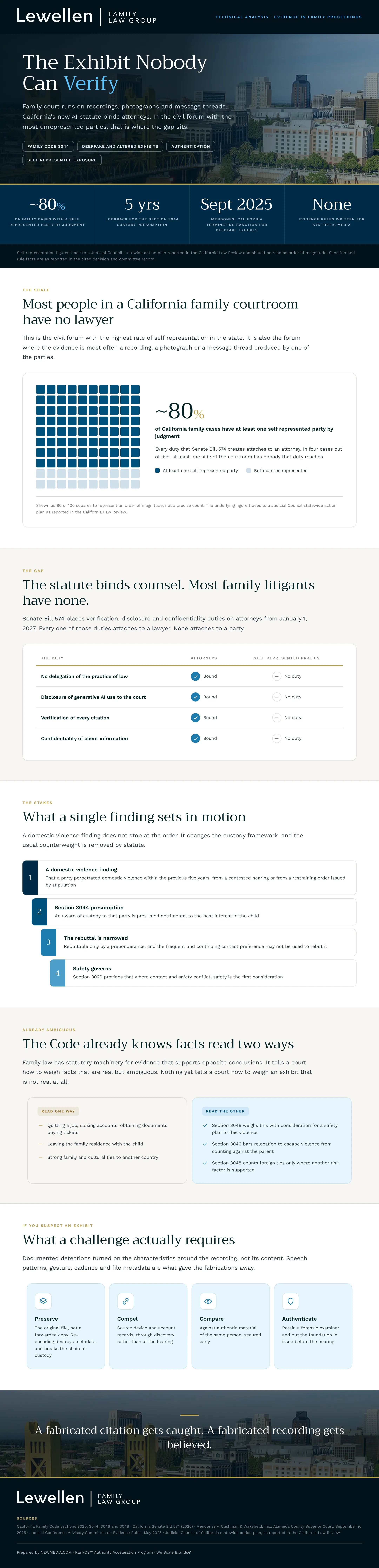
A technical analysis of why California family court is the civil forum most exposed to synthetic evidence, what a California finding of domestic violence sets in motion, and what defending against false domestic violence allegations now requires of both sides.
Fabricated Evidence in Custody and Domestic Violence Proceedings: The Exhibit Nobody Can Verify
Sacramento, CA, Nov. 20, 2026 (GLOBE NEWSWIRE) -- Lewellen Family Law Group P.C., a Northern California family law firm with offices in Sacramento and San Francisco practicing exclusively in family law, has published an analysis of synthetic and altered evidence in custody and domestic violence proceedings. The analysis argues that family court is the civil forum least equipped to absorb the problem, for three reasons that compound: the evidence that decides these cases is precisely the kind generative tools now produce convincingly, the majority of parties appear without counsel, and California's new statute on artificial intelligence reaches attorneys rather than litigants. The burden of challenging a fabricated exhibit falls on the party it is offered against, most often the party defending against false domestic violence allegations, who has to put authenticity in issue before a court has any reason to look twice.
The gap the statute leaves open
Senate Bill 574, signed on September 30, 2026 and effective January 1, 2027, places a California lawyer's obligations around generative artificial intelligence into statute. An attorney may not delegate the practice of law to it, must disclose its use for documents submitted to a court, must verify the accuracy of its output, and must keep confidential information out of systems that are not access restricted.
Every one of those duties attaches to an attorney. None attaches to a party. In most civil case types that distinction is academic, because most civil litigants are represented. Family law is the exception. Work published in the California Law Review, drawing on a Judicial Council of California statewide action plan, put the share of California family law cases with at least one self represented litigant at roughly 70 percent at filing and roughly 80 percent by judgment. Those figures date to 2004 and should be read as the order of magnitude rather than the current number, but no subsequent work has suggested the proportion has fallen.
The practical consequence for anyone defending against false domestic violence allegations is that the forum with the highest rate of unrepresented parties is the forum where the new verification and disclosure architecture has the least reach.
What a finding sets in motion
The stakes in a domestic violence proceeding are not confined to the order itself. California Family Code section 3044 provides that on a finding that a party seeking custody has perpetrated domestic violence within the previous five years against the other party, the child, or the child's siblings, there is a rebuttable presumption that awarding that party sole or joint physical or legal custody is detrimental to the best interest of the child. The presumption may be rebutted only by a preponderance of the evidence. The California courts publish a self help guide to domestic violence restraining orders for parties appearing without counsel.
Two features make it consequential. The first is duration: the finding reaches back five years and the presumption travels with the case. It requires a finding by the court. That finding can come from a contested hearing, and it also follows from a restraining order issued by stipulation: the presumption against sole or joint custody is triggered whenever a restraining order after hearing issues, including one the parties agreed to. (C.C. v. D.V. (2024) 105 Cal.App.5th 101; see In re Marriage of J.G. & K.G. (2025) 110 Cal.App.5th 1214.) The second is what cannot be used to rebut it. Section 3044 provides that the preference for frequent and continuing contact with both parents may not be used to rebut the presumption, in whole or in part. That preference is otherwise central to California custody analysis, and in a relocation dispute it is the factor a court weighs most heavily. Section 3020 completes the structure: where the policy favoring frequent contact and the policy favoring safety conflict, the order must be made in the manner that ensures the health, safety and welfare of the child and the safety of all family members.
The architecture is deliberate and it is protective. It also means that a single evidentiary finding can reset the framework for child custody in California for years. An exhibit that produces that finding carries weight far beyond the hearing it was offered in.
Kimberly Lewellen, a California Board Certified Family Law Specialist and the firm's shareholder, says the asymmetry is what makes the problem urgent rather than theoretical.
“A fabricated citation gets caught, because the case either exists or it does not. A fabricated recording, altered photograph or writing gets believed, unless somebody in the room is equipped to test it. In a custody matter the difference between those two outcomes is a parent's time with a child.”
The record so far
A California trial court has already confronted synthetic evidence directly. In Mendones v. Cushman & Wakefield, Inc., decided on September 9, 2025, Judge Victoria Kolakowski of the Alameda County Superior Court found that self represented plaintiffs had submitted deepfake videos and altered images, holding that two of the exhibits were products of generative AI and did not capture the actual speech and image of the person they purported to show. The court identified the fabrication by comparing the exhibits against authentic footage and noting discrepancies in accent, cadence, volume, word choice, pauses, gestures and facial expression. It imposed a terminating sanction and dismissed the case, finding the sanction proportional to the harm the misuse of the court's processes had caused, and declined to refer the matter for criminal prosecution.
The family law precedent is older and came from the United Kingdom, where in a child custody proceeding a parent produced a doctored audio recording in which the other parent appeared to make violent threats. Forensic examination of the file metadata established that it had been edited after the original call, and the recording was dismissed. The solicitor who challenged it observed that unchallenged it would have portrayed his client as a violent and aggressive man.
That case predates the current generation of synthesis tools. The effort, cost and technical skill required to produce comparable material have all fallen sharply since, and the detection burden has not moved with them. In both matters the fabrication was identified because someone with resources went looking. Neither case tells us how often nobody looks.
The rules have not caught up
There is no specialized evidentiary rule for synthetic media. The Judicial Conference's Advisory Committee on Evidence Rules considered a proposed amendment to Federal Rule of Evidence 901 addressing deepfakes and concluded in May 2025 that an amendment was not necessary at that time, given existing methods for evaluating authenticity and the limited number of instances then before the courts. It retained the proposal for future consideration rather than publishing it.
Authentication in family court, and therefore the work of defending against false domestic violence allegations built on a suspect exhibit, proceeds under the ordinary state court rules, which means it proceeds on the strength of the challenge a party is able to mount. A recording is admitted because a witness says it is what it purports to be. Where no one contests that, nothing in the rules requires a court to look further.
Evidence that already reads two ways
Family law is not naive about ambiguous evidence. The Family Code contains machinery built precisely because the same facts can support opposite conclusions, and that machinery is the closest existing analogue to the problem synthetic evidence presents.
Section 3048 directs a court that becomes aware of facts indicating a risk of child abduction to consider a list of factors. One is whether a party has engaged in planning activities that would facilitate removal of a child from the state, including quitting a job, selling a residence, closing a bank account, obtaining documents or purchasing travel tickets. The statute then qualifies that factor, directing that it be weighed with consideration given to whether a party is carrying out a safety plan to flee from domestic violence. The conduct that looks like preparation to abduct is the same conduct as preparation to escape.
Section 3046 goes further, providing that where a party is absent or relocates because of actual or threatened domestic or family violence by the other party, the court shall not consider the absence or relocation as a factor in determining custody or visitation. The Legislature anticipated that protective conduct would be read against the protected party and legislated against it.
Synthetic evidence is the same problem arriving by a new route. The difference is that section 3048 and section 3046 tell a court how to weigh facts that are real but ambiguous. Nothing yet tells a court how to weigh an exhibit that is not real at all.
What a challenge requires
Challenging a suspect exhibit is a documentary and forensic exercise, and it begins before the hearing. The original file matters more than the copy, because metadata is lost or rewritten when a file is re-encoded, forwarded or exported from a messaging application. The source device and the originating account records are obtained through discovery, not asked for at the hearing. An examiner compares the exhibit against authentic material of the same person, which means authentic material has to be secured early.
The detection in both matters described above came from the same place: not from the content of the recording, but from the characteristics around it. Speech patterns, gesture, cadence and file metadata are what gave the fabrications away.
Lewellen says the firm's position is not that these tools should be treated as a threat to be avoided.
“The advantage goes to the side that knows how to use these tools, knows how to convincingly discredit evidence, and knows when the output is wrong, including when the output is coming from the other side. Those are different skills that only seasoned trial counsel can effectively address. These skills can decide a case.”
The firm keeps that capability within the practice. Amrit Kullar, a senior attorney, holds the Artificial Intelligence Governance Professional credential from the International Association of Privacy Professionals alongside privacy certifications covering the United States, Europe, Canada and Asia. Amanda N. Sanchez, a senior attorney, practices extensively in domestic violence matters. The firm represents both sides of these proceedings, parties seeking protection and parties responding to allegations, and both sides of that work turn on the same question: whether the evidence put in front of the court can be tested.
The Sacramento timetable
Where this plays out matters, because the clock is not the same everywhere. Sacramento County hears family law at the William R. Ridgeway Family Relations Courthouse on Power Inn Road, and the wider region is administered by four separate superior courts, Sacramento, Placer, El Dorado and Yolo, each with its own local rules, settlement conference practice and customary approach to expert appointment. A party contesting domestic violence restraining orders in Sacramento County is therefore working to one court's expectations about what an examiner must produce and when, and those expectations are not uniform across the corridor.
The statutory timetable compresses everything described above. Family Code section 242 requires the hearing on the petition to be held within 21 days of the date a temporary restraining order is granted or denied, or 25 days where the court finds good cause. Forensic examination of a disputed recording does not run on that schedule. Obtaining an original file rather than a forwarded copy, securing the source device, subpoenaing originating account records and retaining an examiner are each measured in weeks, and the first of them has to begin before a responding party has finished reading the application. California sets no case disposition time standard for family law, so there is no published backstop to appeal to either. The practical consequence is that a challenge to a fabricated exhibit is usually won or lost on what was requested in the first week, not on what is argued at the hearing.
Frequently asked questions
Can deepfake audio or video be used as evidence in a custody case?
Fabricated recordings have been submitted in custody and civil proceedings and detected through forensic examination. In Mendones v. Cushman & Wakefield, Inc. a California court imposed a terminating sanction in September 2025 after finding submitted video exhibits were deepfakes. There is no specialized rule for synthetic media in California or in the Federal Rules of Evidence, so challenges proceed under ordinary authentication rules and depend on the challenge a party mounts.
How do I challenge evidence I believe was altered or generated by AI?
Defending against false domestic violence allegations starts with the file. Preserve the original rather than a forwarded copy, because metadata is lost on re-encoding. Maintaining a chain of custody is critical, because it is what allows a party to show that a document is true and accurate, or that it has been materially altered to misrepresent the evidence. Obtain the source device and account records through discovery, and retain a forensic examiner to compare the exhibit against authentic material of the same person. Documented detections have turned on speech patterns, gesture and file metadata rather than on the content of the recording.
What happens if a court finds domestic violence occurred in my custody case?
California Family Code section 3044 creates a rebuttable presumption that awarding sole or joint custody to a party found to have perpetrated domestic violence within the previous five years is detrimental to the child. It can be rebutted only by a preponderance of the evidence, and the preference for frequent and continuing contact with both parents may not be used to rebut it.
Does California's new AI law protect me from fabricated evidence filed by the other side?
Not directly, and it does not by itself assist a party defending against false domestic violence allegations. Senate Bill 574 places duties on attorneys, including verification and disclosure, and takes effect January 1, 2027. It does not impose equivalent duties on a self represented party. In family law, where a large majority of cases involve at least one unrepresented party, that gap is the practical exposure.
Key Facts
|
Related resources
- domestic violence and restraining order representation
- Sacramento family law attorneys
- child custody representation in California
- how Lewellen Family Law Group uses AI in litigation
- California Courts self help, domestic violence restraining orders
- Judicial Conference Advisory Committee on Evidence Rules
About Lewellen Family Law Group P.C.
Lewellen Family Law Group P.C. is a Northern California family law firm with offices in Sacramento and San Francisco. The firm practices exclusively in family law, with emphasis on complex property division, business and professional practice valuation, executive and equity compensation, child custody including interstate and international matters, domestic violence, and mediation. The practice is led by a California Board Certified Family Law Specialist and works with forensic accounting and valuation professionals on complex asset matters and a senior attorney certified in artificial intelligence governance and privacy. The firm serves Sacramento, Placer, El Dorado and Yolo counties, the San Francisco Bay Area, Silicon Valley, and the Napa and Sonoma valleys.
For more information please visit: https://californiafamilylaw.com
# # #








Comments (0)
Login to join the conversation
Login / RegisterNo comments yet. Be the first to comment!