
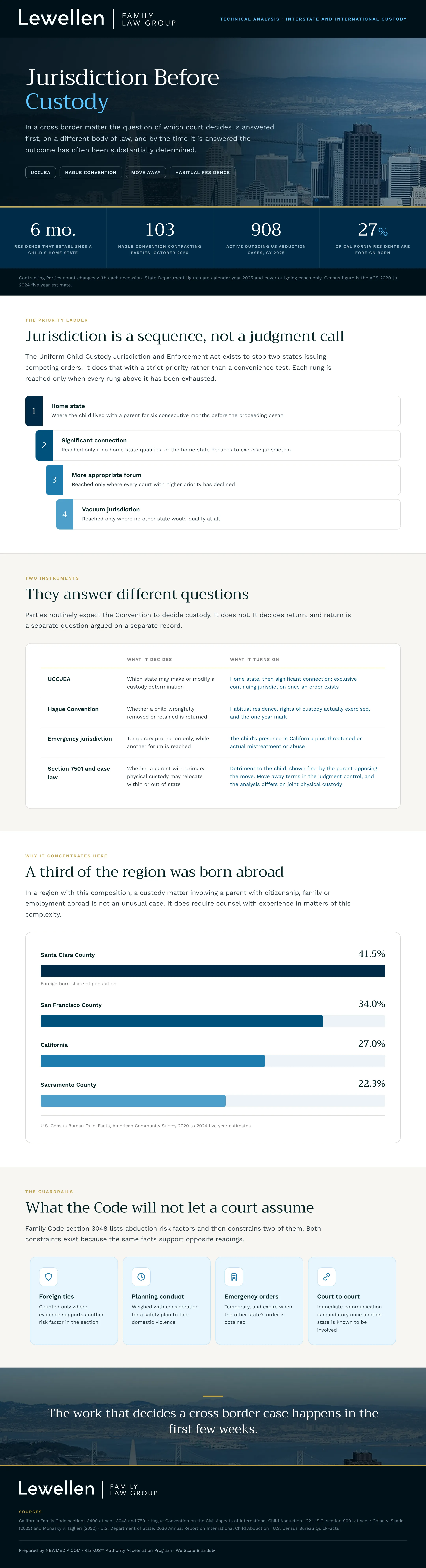
A technical analysis of the Uniform Child Custody Jurisdiction and Enforcement Act, the Hague Convention return remedy, and California relocation law, in a region where a third of adults were born abroad.
Child Custody in California: Jurisdiction First - UCCJEA, the Hague Convention and California Relocation Law
San Francisco, CA, Nov. 23, 2026 (GLOBE NEWSWIRE) -- Lewellen Family Law Group P.C., a Northern California family law firm with offices in San Francisco and Sacramento practicing exclusively in family law, has published an analysis of jurisdiction and relocation in custody matters that cross a state or national border. The analysis makes a structural point that is frequently missed by parties and sometimes by counsel: in a cross border matter the question of which court decides is answered first, it is answered on a different body of law than the custody question itself, and by the time it is answered the outcome has often been substantially determined. That is why international child custody matters in California are decided on the jurisdictional record built in the first few weeks.
The question that comes first
California, like every other state, has adopted the Uniform Child Custody Jurisdiction and Enforcement Act, codified at Family Code section 3400 and following. The Act exists to prevent two states from issuing competing custody orders over the same child, and it does that by establishing a strict priority of jurisdiction rather than leaving the question to convenience.
The first tier is home state. The Act defines a child's home state as the state in which the child lived with a parent, or a person acting as a parent, for at least six consecutive months immediately before the commencement of a custody proceeding, with a temporary absence counted as part of the period. For a child under six months old, it is the state in which the child has lived from birth. Only if no state qualifies as home state, or the home state declines, does a court reach the second tier, which asks whether the child and at least one parent have a significant connection with the state beyond mere physical presence and whether substantial evidence concerning the child is available there.
In international child custody matters in California the six month figure does the work, and it is where cases are won and lost before a case is filed. A family that relocates in August and separates in November has produced a jurisdictional question with a determinate answer, and that answer is fixed by a calendar.
Kimberly Lewellen, a California Board Certified Family Law Specialist and the firm's shareholder, says the sequence is routinely misunderstood by a party arriving at a California court when the six month period has not yet been reached.
“A parent who has taken a child to another state, or to this state, may have done so under the false pretense of ‘visiting family’ or needing time to think about the relationship, only to file for custody in their arrival state. Time is of the essence in determining the proper jurisdiction to decide custody, which is a function of home state jurisdiction and proper forum.”
Once a California court makes an initial determination in an international child custody matter, it retains exclusive continuing jurisdiction. Another state cannot modify a California order merely because the family has moved, which is the provision that prevents a parent from improving their position by relocating and filing afresh.
Emergency jurisdiction, and what it is not
The Act provides one route around the priority. A California court has temporary emergency jurisdiction if the child is present in the state and has been abandoned, or if it is necessary in an emergency to protect the child because the child, or a sibling or parent of the child, is subjected to or threatened with mistreatment or abuse.
Three features of that provision are worth stating precisely, because it is the provision a parent fleeing violence relies on. The child must be physically present in California. The mistreatment or abuse ground extends to a sibling or a parent of the child, not only to the child. And a threat suffices; the harm need not have occurred. The Legislature was explicit about the purpose, recording its intent that the grounds for emergency jurisdiction be expanded and that they include cases involving domestic violence.
What the provision is not is a substitute for jurisdiction. An order made on this basis is temporary. Where another state holds a prior order or has a proceeding underway, the California order must specify a period adequate for the party to obtain an order from that state, and it expires when that period does. The Act also imposes a duty of immediate court to court communication once a California court learns that another state is involved.
When the border is international
Where a child has been taken to or retained in another country, the governing instrument is the Hague Convention on the Civil Aspects of International Child Abduction, implemented in the United States by the International Child Abduction Remedies Act at title 22 of the United States Code, section 9001 and following. The Convention entered into force for the United States on July 1, 1988, and the HCCH status table for the Convention records 103 Contracting Parties. The U.S. Department of State administers the United States side as Central Authority.
The Convention does not decide custody. It decides return. A removal or retention is wrongful where it breaches rights of custody under the law of the state in which the child was habitually resident immediately before it, and those rights were actually being exercised or would have been but for the removal. Where proceedings commence less than one year from the wrongful removal, the authority shall order return forthwith. After one year return is still ordered unless it is demonstrated that the child is now settled in the new environment. The one year period runs to the commencement of proceedings, not to the date an application reaches a central authority, and it is not a bar.
The defense most often raised, and the one that matters most in matters involving violence, is the grave risk exception: return is not required where the person opposing it establishes that there is a grave risk that return would expose the child to physical or psychological harm or otherwise place the child in an intolerable situation. In 2022 the Supreme Court held unanimously in Golan v. Saada that a court is not categorically required to examine all possible ameliorative measures before denying a return petition once it has found that return would expose the child to a grave risk of harm. Two years earlier, in Monasky v. Taglieri, the Court held that habitual residence depends on the totality of the circumstances specific to the case, that an actual agreement between parents is not necessary to establish an infant's habitual residence, and that a first instance determination is reviewed only for clear error.
The volume is not trivial. The State Department's 2026 annual report records 908 active outgoing abduction cases for calendar year 2025, comprising 845 return applications involving 1,164 children and 63 access applications. One hundred sixty nine cases were resolved with 256 children returned to the United States. India, Brazil and Canada appear most frequently, and fourteen countries were cited for a pattern of noncompliance.
Relocation inside California
A move that does not cross a border raises its own question. Family Code section 7501 provides that a parent entitled to the custody of a child has a right to change the residence of the child, subject to the power of the court to restrain a removal that would prejudice the rights or welfare of the child. As the case law has interpreted that provision, the right runs to the parent with primary physical custody. The Legislature added a second subdivision affirming the Supreme Court's decision in In re Marriage of Burgess and declaring it the public policy and law of the state. Relocation disputes of this kind are argued as part of child custody representation rather than as a separate proceeding.
In re Marriage of LaMusga refined rather than reversed that framework. A custodial parent still does not have to establish that a planned move is necessary. What LaMusga established is that the noncustodial parent bears the initial burden of showing the proposed relocation would cause detriment to the children requiring reevaluation of custody, and that the likely impact of the move on the noncustodial parent's relationship with the children is a relevant factor in that analysis. The court set out the considerations that follow, including the children's interest in stability, the distance of the move, the children's ages, their relationship with both parents, the parents' ability to communicate and cooperate, the children's wishes where they are mature enough, the reasons for the move, and the extent to which the parents currently share custody.
Burgess itself flagged that a different analysis may be required where parents share joint physical custody under an existing order and in fact, and one seeks to relocate. In that situation the court determines afresh what arrangement for primary custody is in the child's best interest. The distinction between a sole custody relocation and a joint custody relocation is therefore not a matter of degree.
The factor the Legislature deliberately subordinated
For international families, one provision deserves attention because it cuts against an assumption courts might otherwise make. Family Code section 3048 directs a court that becomes aware of facts indicating a risk of abduction to consider a list of factors, one of which is whether a party has strong familial, emotional or cultural ties to another state or country, including foreign citizenship.
The statute then constrains that factor. It provides that it shall be considered only if evidence exists in support of another factor specified in the section. A parent's foreign nationality, family abroad, or cultural connection to another country cannot on its own establish abduction risk. It becomes relevant only alongside something else, such as a prior taking, a threat, or concrete planning activity.
The same section qualifies the planning activities factor in the other direction, directing that conduct such as quitting a job, closing accounts, obtaining documents or purchasing travel tickets be weighed with consideration given to whether a party is carrying out a safety plan to flee from domestic violence. Both qualifications reflect the same legislative judgment: in cross border family matters the facts frequently support more than one reading, and the Code says so.
Why this concentrates here
The Census Bureau's American Community Survey five year estimates for 2020 through 2024 place the foreign born share of California's population at 27.0 percent. In San Francisco County it is 34.0 percent and in Santa Clara County 41.5 percent. In Sacramento County it is 22.3 percent. More than two in five California residents aged five and over speak a language other than English at home.
In a region with that composition, a custody matter involving a parent with citizenship, family or employment abroad is not an unusual case, but it does require counsel with experience in matters of this complexity. The jurisdictional question in it is answered on the Uniform Act, the Convention, or both, before anyone reaches the parenting plan.
Lewellen says the practical consequence is a sequencing one.
“The work that decides a cross border case happens in the first few weeks of the case and requires proactive advocacy. It is establishing where the child was living, what order exists, which authority has to be notified, and whether a clock has already started running.”
Lewellen Family Law Group practices exclusively in family law and handles interstate and international custody matters in the California state courts, alongside complex property division, support, domestic violence and mediation, from its San Francisco family law office and its Sacramento family law office, the two counties named above.
Frequently asked questions
Which state decides custody if we moved recently?
In international child custody matters in California, under the Uniform Child Custody Jurisdiction and Enforcement Act, priority goes to the child's home state, meaning the state where the child lived with a parent for at least six consecutive months immediately before the proceeding commenced. Only if no state qualifies, or the home state declines, does a court consider significant connection and available evidence.
Can I move out of California with my child after a divorce?
A judgment on custody will normally include move away terms, and those depend on physical custody. A parent with primary physical custody has a statutory right to change the child's residence, subject to the court's power to restrain a move that would prejudice the child. Unless a judgment or court order states otherwise, the custodial parent moving need not prove the move is necessary, but the other parent may show the move would cause detriment requiring reevaluation of custody, and the analysis differs where the parents share joint physical custody.
What happens if my child is taken to another country?
Where that country is a Hague Convention party, a return petition may be filed and return is ordered where the removal breached rights of custody under the law of the child's habitual residence. Filing within one year of the removal matters, because after that the other parent may raise that the child is now settled. Return is a separate question from custody.
Does my former spouse's foreign citizenship mean the court will see abduction risk?
Not by itself. California Family Code section 3048 lists ties to another country, including foreign citizenship, among the abduction risk factors, but provides that this factor shall be considered only if evidence supports another factor in the section, such as a prior taking, a threat, or concrete planning activity.
Key Facts
|
Related resources
- interstate and international family law attorneys
- child custody representation in California
- San Francisco family law attorneys
- Lewellen Family Law Group
- Hague Conference on Private International Law, Convention No. 28
- U.S. Department of State, international parental child abduction
About Lewellen Family Law Group P.C.
Lewellen Family Law Group P.C. is a Northern California family law firm with offices in San Francisco and Sacramento. The firm practices exclusively in family law, with emphasis on complex property division, business and professional practice valuation, executive and equity compensation, child custody including interstate and international matters, domestic violence, and mediation. The practice is led by a California Board Certified Family Law Specialist and works with forensic accounting and valuation professionals on complex asset matters. The firm serves the San Francisco Bay Area, Silicon Valley, the Napa and Sonoma valleys, and Sacramento, Placer, El Dorado and Yolo counties.
For more information please visit: https://californiafamilylaw.com
# # #







Comments (0)
Login to join the conversation
Login / RegisterNo comments yet. Be the first to comment!