
Top 10 Companies Hold 40.22% of a USD 167.71 Billion AI Automation Market: Precedence Research Company Intelligence on Expansion, Investment, Deployment and Enterprise Adoption
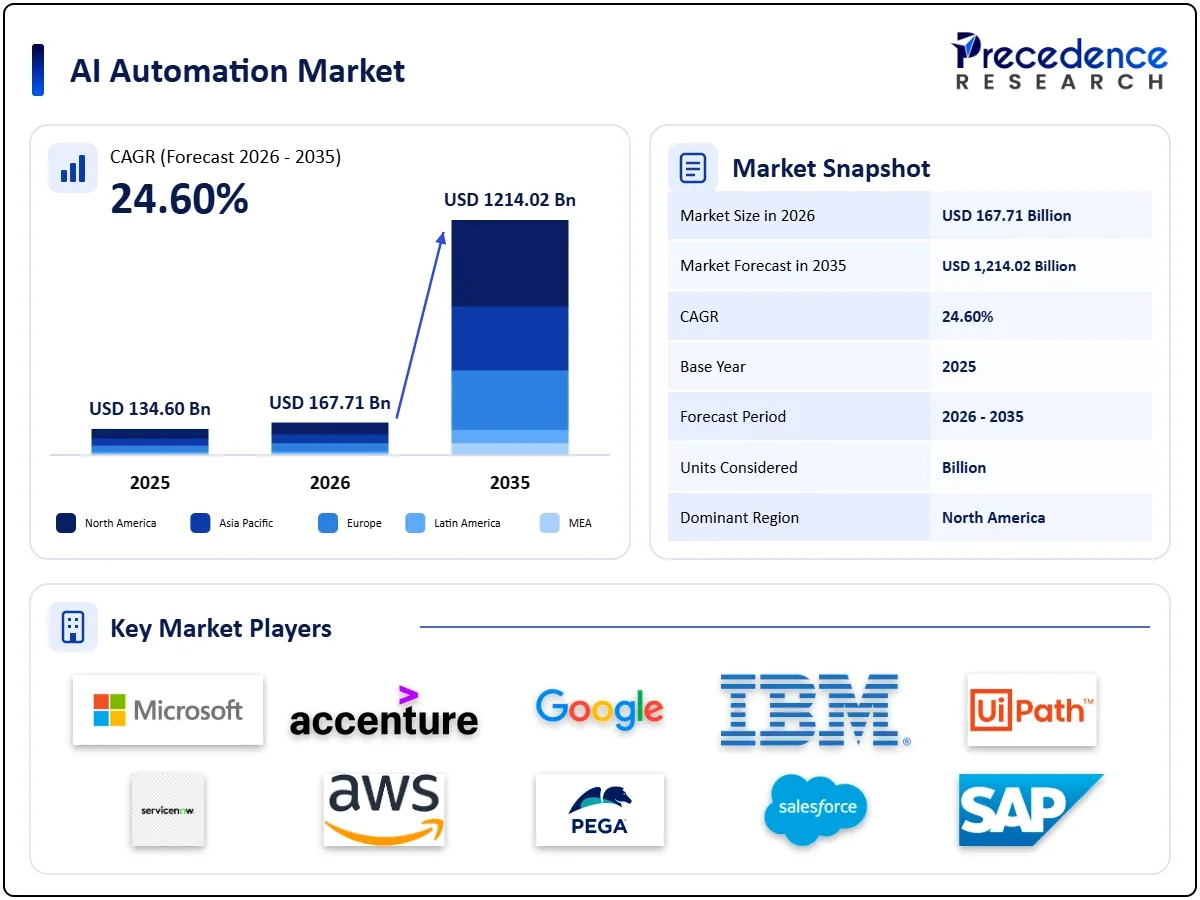
Ottawa, Nov. 04, 2026 (GLOBE NEWSWIRE) -- Precedence Research today released updated company intelligence on the global AI automation market, which covers software and services that use AI to run business processes, IT operations, customer conversations and decisions with less manual effort. The market is valued at USD 167.71 billion in 2026 and is forecast to reach USD 1,214.02 billion by 2035, adding USD 1,046.31 billion in annual revenue.
The global AI automation market is valued at USD 167.71 billion in 2026, up from USD 134.60 billion in 2025, and is projected to reach USD 1,214.02 billion by 2035 at a CAGR of 24.60%. Microsoft leads with an estimated 10.55% share, the ten largest vendors together earn USD 54.13 billion, and conversational and agentic AI automation is the fastest-growing category. The competitive picture is shifting fast. Rule-based bots are giving way to AI agents that plan, act across applications and hand off to people only when needed. Every major platform vendor now sells an agent layer: Microsoft through Copilot and Agent 365, Salesforce through Agentforce, ServiceNow through its AI Platform, SAP through Joule, and AWS and Google through their agent-building services. Specialists such as UiPath, Pegasystems, Automation Anywhere and Workato are repositioning around agent orchestration, while OpenAI has entered the enterprise directly with its Frontier platform.
This release focuses on the companies: who holds share, how they are expanding and investing, how enterprises are deploying and adopting their products, and which technology trends will decide positioning through 2035.
Request a sample: https://www.precedenceresearch.com/sample/8865
Figure 1: AI Automation Market Size, Regional Share and Automation Type Share
Sources: Expert Interview, Secondary Sources, Precedence Research Database, Precedence Research Analysts and Researcher
Fill out the form for relevant samples, case studies, and examples. sales@precedenceresearch.com
Key Segments: 2025 Share and 2026 Value
| Segment | 2025 Share | 2026 Value (modeled) | Growth Signal |
| Intelligent process automation | 34.60% | USD 58.03 billion | Largest automation type |
| Conversational & agentic AI automation | 24.20% | USD 40.59 billion | Fastest-growing type |
| IT operations automation (AIOps) | 17.80% | USD 29.85 billion | Steady demand from IT teams |
| Decision & analytics automation and others | 23.40% | USD 39.24 billion | Decision automation gains with agents |
| Cloud deployment | 68.40% | USD 114.71 billion | Dominant delivery model |
| SMEs | 33.80% | USD 56.69 billion | Faster-growing enterprise size |
| Healthcare end use | 12.20% | USD 20.46 billion | Fastest-growing end use |
Sources: Expert Interview, Secondary Sources, Precedence Research Database, Precedence Research Analysts and Researcher
2026 values apply the published 2025 shares to the official 2026 market size of USD 167.71 billion. Regionally, North America holds 36.80% of 2025 revenue, followed by Asia Pacific (27.20%), Europe (25.40%), Latin America (5.60%) and the Middle East & Africa (5.00%). Asia Pacific grows fastest as Indian IT services firms, Chinese cloud providers and Japanese and Korean manufacturers scale AI agents.
Sources: Expert Interview, Secondary Sources, Precedence Research Database, Precedence Research Analysts and Researcher
Key Companies and Company Market Share
Figure 2: Top 10 Companies by AI Automation Revenue and Market Share, 2025
Sources: Expert Interview, Secondary Sources, Precedence Research Database, Precedence Research Analysts and Researcher
| Rank | Company | 2025 Revenue (est.) | Share | Headquarters |
| 1 | Microsoft | USD 14.20 billion | 10.55% | United States |
| 2 | Amazon Web Services | USD 7.40 billion | 5.50% | United States |
| 3 | Accenture | USD 6.80 billion | 5.05% | Ireland |
| 4 | IBM | USD 5.90 billion | 4.38% | United States |
| 5 | USD 5.10 billion | 3.79% | United States | |
| 6 | ServiceNow | USD 4.80 billion | 3.57% | United States |
| 7 | Salesforce | USD 4.20 billion | 3.12% | United States |
| 8 | SAP | USD 3.10 billion | 2.30% | Germany |
| 9 | UiPath | USD 1.61 billion | 1.20% | United States |
| 10 | Pegasystems | USD 1.02 billion | 0.76% | United States |
| Top 10 combined | USD 54.13 billion | 40.22% | ||
| All other companies | USD 80.47 billion | 59.78% |
Fill out the form for relevant samples, case studies, and examples. sales@precedenceresearch.com
The market is moderately fragmented. Microsoft's lead rests on its installed base in productivity software and Azure; no other vendor holds more than about 5.5%. Hyperscalers (Microsoft, AWS, Google) together hold about 19.8%, application platforms (ServiceNow, Salesforce, SAP) about 9.0%, and services firms such as Accenture and IBM capture a large share through implementation and managed automation. Specialists such as UiPath and Pegasystems hold smaller shares but lead in process orchestration and case management. Almost 60% of revenue sits with other vendors, including Automation Anywhere, Appian, Celonis, Workato, Oracle, Workday, and many regional integrators and startups.
Company Positioning and Latest Performance
Figure 3: Latest Reported Growth Signals from AI Automation Leaders
Sources: Expert Interview, Secondary Sources, Precedence Research Database, Precedence Research Analysts and Researcher
| Company | Positioning | Latest Reported Performance | Strategic Focus |
| Microsoft | Platform leader across productivity, cloud and developer tools | FY27 Q1 (Oct 2026): revenue USD 92.3B; Azure +48%; Agent 365 registry above 50 million agents; 120,000+ Foundry customers | Agent management, Copilot and Foundry |
| Amazon Web Services | Largest cloud infrastructure provider | Added agentic features to Amazon Connect and Amazon Quick; OpenAI models available on Bedrock (Apr 2026) | Agent-building services and contact-center automation |
| Accenture | Largest automation implementation partner | Q4 FY26: revenue USD 18.70B (+6%); bookings USD 22.2B; about USD 4B of cybersecurity deals completed | Managed automation services and AI acquisitions |
| IBM | Hybrid-cloud software plus consulting | Q3 2026: revenue USD 17.10B (+5%); software +8%; generative AI about 35% of consulting backlog | watsonx agents and consulting-led deployment |
| AI models plus cloud platform | Q3 2026: Google Cloud revenue USD 30.71B (+103%); backlog USD 561B; nearly 32 billion API tokens per minute | Gemini models and enterprise agent platform | |
| ServiceNow | Workflow platform for IT, HR and customer service | Q3 2026: subscription revenue USD 3.99B (+21%); 2026 AI ACV target raised to USD 1.7B; agentic consumption up 13x | AI Platform, Moveworks, Armis and Veza integration |
| Salesforce | CRM and customer-service automation | Q2 FY27: revenue USD 11.35B (+11%); Agentforce ARR above USD 1.5B (+240%); Agentforce and Data 360 ARR nearly USD 3.9B | Agentforce 360 and Informatica data layer |
| SAP | ERP and business process platform | Q3 2026: cloud revenue EUR 6.7B (+25%); current cloud backlog EUR 24.1B (+26%) | Joule agents embedded in ERP processes |
| UiPath | Agentic process automation specialist | Q2 FY27: revenue USD 410M (+13%); ARR USD 1.938B (+12%); net retention 109% | Maestro orchestration and vertical agents |
| Pegasystems | Case management and workflow | Q3 2026: revenue USD 393.4M (+3%); Pega Cloud ACV USD 976M (+20%) | Cloud migration and GenAI-led app design |
Sources: Expert Interview, Secondary Sources, Precedence Research Database, Precedence Research Analysts and Researcher
The pattern is clear: vendors that own the data and the workflow are converting their customer bases to AI agents fastest. Salesforce's Agentforce ARR more than tripled in a year, ServiceNow raised its AI target by 70% within 2026, and Microsoft now tracks more than 50 million agents. Specialists are growing more slowly, but their orchestration tools remain important where processes span many systems.
Fill out the form for relevant samples, case studies, and examples. sales@precedenceresearch.com
Company Expansion Strategies
Acquiring agent and data capabilities. ServiceNow completed its acquisition of Moveworks in December 2025, adding an AI assistant and enterprise search, then bought identity firm Veza (March 2026) and closed the USD 7.75 billion cash purchase of Armis (April 2026), which it says will more than triple its security and risk addressable market. Salesforce's Informatica acquisition added USD 440 million to subscription revenue in a single quarter, and Contentful and Fin are pending. Automation Anywhere acquired Aisera for IT, HR and customer-service agents.
Launching agent platforms. Salesforce launched Agentforce 360 and OpenAI launched AgentKit in October 2025. OpenAI followed with Frontier, a platform for enterprises to build and manage AI agents, in February 2026. Microsoft unified its Copilot products around Agent 365 for registering and governing agents.
Moving into vertical solutions. UiPath launched agentic AI offerings for healthcare providers and payers in February 2026, targeting claims, prior authorization and revenue-cycle work. Healthcare is the fastest-growing end use in the report.
Building for open standards. Workato launched production-ready Model Context Protocol (MCP) servers in February 2026, and UiPath joined the Agentic AI Foundation, which now hosts MCP. Interoperability lets vendors plug into agents built on other platforms rather than compete for every workload.
Expanding through services. Accenture completed about USD 4 billion of cybersecurity acquisitions in fiscal 2026 and was reported to be acquiring UK AI firm Faculty, adding delivery capacity for AI automation programs.
Company Investment Strategies
- Infrastructure first: Microsoft (USD 45.2 billion capex in its latest quarter), Google and AWS are investing heavily in AI data centers, so they can supply the compute that automation agents run on and sell it through their clouds.
- Buy rather than build: ServiceNow and Salesforce are spending billions on acquisitions to add AI assistants, security, identity and data management around their workflow platforms.
- Consumption pricing: vendors are shifting from per-seat licenses to usage- and agent-based pricing; ServiceNow reports agentic AI consumption up more than 13 times year over year.
- Cloud migration: Pegasystems is moving customers to Pega Cloud, now 59% of its ACV, so that AI features ship faster.
- Ecosystem funding: venture investors continue to fund workflow and agent startups such as n8n (USD 180 million Series C at a USD 2.5 billion valuation, October 2025), giving larger vendors a pipeline of acquisition targets.
Software Deployment and Enterprise Adoption
Cloud dominates deployment. Cloud deployment holds 68.40% of 2025 revenue (about USD 114.71 billion in 2026), because AI agents rely on hosted models, frequent updates and usage-based billing. On-premises deployment (31.60%) remains important in banking, government and healthcare, where data-residency rules apply.
Adoption is moving from pilots to production. Company disclosures show agents moving into daily work: Microsoft's Agent 365 registry grew more than 30% in one quarter to over 50 million agents, ServiceNow's count of customers paying more than USD 5 million in ACV reached 680 (+23%), and agent-generated pull requests on GitHub rose six-fold in six months.
Large enterprises lead, SMEs grow faster. Large enterprises hold 66.20% of revenue because they run the complex processes where automation saves the most. SMEs (33.80%) are adopting faster through low-code tools and agents built into the software they already use.
| Adoption Area | Typical Use Cases | Leading Vendors |
| IT operations | Ticket triage, incident response, self-service | ServiceNow, IBM, Microsoft |
| Customer service | Agent-led case handling, contact centers | Salesforce, AWS (Amazon Connect), Google |
| Finance and back office | Invoice processing, reconciliation, ERP tasks | SAP, UiPath, Automation Anywhere |
| Software development | Coding agents, testing, code migration | Microsoft (GitHub), Google, AWS |
| Healthcare administration | Claims, prior authorization, revenue cycle | UiPath, Pegasystems, Microsoft |
Operational Efficiency Gains
Efficiency remains the main reason enterprises buy. Companies report shorter cycle times in software engineering (Amazon's Prime Video unit cut a major code rewrite from two years to two quarters using AI agents), lower cost per support case as agents resolve routine requests, and fewer manual handoffs in finance and HR. Vendors are increasingly selling on measured outcomes, such as cases resolved or hours saved, rather than on licenses.
Sources: Expert Interview, Secondary Sources, Precedence Research Database, Precedence Research Analysts and Researcher
Technology Trends Shaping Competitive Positioning
- Agentic AI: agents that plan and act across systems are replacing scripted bots, which is why conversational and agentic AI automation is the fastest-growing segment.
- Agent governance and control towers: Microsoft's Agent 365 and ServiceNow's AI control tower register, monitor and secure agents across vendors.
- Open protocols: MCP and similar standards let agents call tools from any vendor, lowering switching costs.
- Data platforms as foundations: Salesforce (Informatica, Data 360) and SAP (Business Data Cloud) tie agents to trusted business data.
- Coding agents: AI coding tools are automating software development itself, with UiPath linking its orchestration to coding agents.
- Vertical agents: industry-specific agents for healthcare, banking and insurance shorten time to value.
Key Market Drivers
- Rapid gains in generative AI and machine learning model capability.
- Enterprise pressure to cut costs and improve productivity through digital transformation.
- Agents built into widely used platforms, which lowers the cost of adoption.
- Growth of cloud computing and usage-based pricing that suits smaller buyers.
Major Challenges
- Security, identity and governance risks when agents act on business systems.
- Data quality and integration gaps across legacy applications.
- Uncertain return on investment for early pilots and changing pricing models.
- Pressure on traditional seat-based software revenue as agents replace manual work.
Emerging Opportunities
- Healthcare automation, the fastest-growing end use, in claims, prior authorization and patient access.
- Agent governance and security, as enterprises register and control millions of agents.
- SME offerings through low-code and embedded agents.
- Asia Pacific expansion, the fastest-growing region at a 26.17% CAGR.
- Intelligent process automation upgrades that add AI agents to existing bot estates.
Company Ecosystem
Figure 5: AI Automation Company Ecosystem, 2026
The supply side has three layers: enterprise platforms and hyperscalers that own users and data; process and agentic automation specialists that orchestrate work across systems; and model and infrastructure providers that supply the intelligence and compute. System integrators such as Accenture, Deloitte, Infosys and TCS connect these layers to buyers. On the demand side, BFSI is the largest end use (23.60%), followed by IT and telecom, government, manufacturing, retail and e-commerce, and healthcare, the fastest-growing.
Customer and Buyer Intelligence
| Target Account Group | Decision-Makers | Purchase Signals | Commercial Opportunity |
| Banks and insurers | COO, CIO, Head of Operations | Cost programs, compliance backlogs | Process and decision automation |
| Healthcare payers and providers | CFO, Revenue Cycle Head | Claims volumes, staffing gaps | Claims and prior-authorization agents |
| IT and telecom companies | CIO, Head of IT Operations | Ticket growth, network complexity | AIOps and service-desk agents |
| Government agencies | CIO, Digital Services Lead | Modernization programs | Citizen-service and case automation |
| Manufacturers and retailers | COO, Supply Chain Head | ERP upgrades, e-commerce growth | Order, inventory and support automation |
| SMEs | Founder, Operations Head | Cloud software adoption | Embedded and low-code agents |
Sources: Expert Interview, Secondary Sources, Precedence Research Database, Precedence Research Analysts and Researcher
How Precedence Research Supports Decision-Making
Master Dataset provides segment, regional and company data for AI automation and adjacent markets such as artificial intelligence, IT services and predictive maintenance. It helps teams size demand by automation type, deployment and end use.
Precedence Quadrant compares vendors on share, growth, product breadth and agent capabilities, helping buyers shortlist partners and vendors benchmark rivals.
Interactive Intelligence Dashboard tracks launches, acquisitions, funding rounds and quarterly results, so sales and strategy teams can respond to competitor moves quickly.
Quality & Manufacturing Intelligence maps vendor delivery capacity, partner networks and implementation quality, supporting sourcing decisions.
Customized Research answers specific questions, such as vendor selection for a use case, pricing benchmarks or entry plans for a country.
| Solution | What It Provides | How It Helps |
| Master Dataset | Segment, region and company data on AI automation | Sizes demand by type, deployment and end use |
| Precedence Quadrant | Vendor comparison on share, growth and capability | Shortlists partners and benchmarks rivals |
| Interactive Dashboard | Live tracking of launches, deals and results | Times sales and investment moves |
| Quality & Manufacturing Intelligence | Delivery capacity and partner mapping | Supports vendor and partner choices |
| Customized Research | Use-case, pricing and country studies | Answers decision-specific questions |
Sources: Expert Interview, Secondary Sources, Precedence Research Database, Precedence Research Analysts and Researcher
Why Continuously Updated Intelligence Matters
AI automation vendors launch products monthly and report new AI metrics every quarter. Monthly updates suit sales and product teams tracking launches and deals. Quarterly updates match vendor earnings and help buyers review partners. Six-monthly updates help strategy teams follow pricing and standards changes, and annual updates support investors reviewing market size and share. Precedence Research offers all four update cycles.
Strategic Outlook
- CEOs and CXOs: the market adds USD 1,046.31 billion by 2035; choose platform partners now, as agent standards and data layers are being set.
- Strategy and business development teams: the top 10 hold only 40.22%, leaving room for specialists in healthcare, finance and Asia Pacific.
- R&D leaders: invest in agent orchestration, governance and MCP-compatible integrations.
- Procurement teams: expect usage-based pricing; negotiate outcome measures and agent governance terms.
- Investors: acquisitions by ServiceNow, Salesforce and Automation Anywhere show that agent, data and security startups are prime targets.
- Partners and integrators: services remain essential, as Accenture's and IBM's AI backlogs show.
Sources: Expert Interview, Secondary Sources, Precedence Research Database, Precedence Research Analysts and Researcher
Call to Action
To see which companies will lead AI automation through 2035 and where your organization fits, explore the full report or speak with a Precedence Research analyst.
- Report: https://www.precedenceresearch.com/ai-automation-market
- Request a sample: https://www.precedenceresearch.com/sample/8865
- Schedule a meeting: https://www.precedenceresearch.com/schedule-meeting
Fill out the form for samples, case studies, and examples. sales@precedenceresearch.com
Related Reports
- Intelligent Process Automation Market: https://www.precedenceresearch.com/intelligent-process-automation-market
- Generative AI Market: https://www.precedenceresearch.com/generative-ai-market
- Artificial Intelligence Market: https://www.precedenceresearch.com/artificial-intelligence-market
- Machine Learning Market: https://www.precedenceresearch.com/machine-learning-market
- IT Services Market: https://www.precedenceresearch.com/it-services-market
- Predictive Maintenance Market: https://www.precedenceresearch.com/predictive-maintenance-market
- Generative AI in Fulfillment and Logistics Market: https://www.precedenceresearch.com/generative-ai-in-fulfillment-and-logistics-market
- AI in Asset Management Market: https://www.precedenceresearch.com/ai-in-asset-management-market
- Generative AI in HR Market: https://www.precedenceresearch.com/generative-ai-in-hr-market
- AI in Food Market: https://www.precedenceresearch.com/ai-in-food-market
- Cloud Computing Market: https://www.precedenceresearch.com/cloud-computing-market
- Hybrid Cloud Market: https://www.precedenceresearch.com/hybrid-cloud-market
- Digital Transformation Market: https://www.precedenceresearch.com/digital-transformation-market
- Advanced Analytics Market: https://www.precedenceresearch.com/advanced-analytics-market
- Data Analytics Market: https://www.precedenceresearch.com/data-analytics-market
- Cyber Security Market: https://www.precedenceresearch.com/cyber-security-market
- Software Market: https://www.precedenceresearch.com/software-market
- Edge Computing Market: https://www.precedenceresearch.com/edge-computing-market
- Internet of Things Market: https://www.precedenceresearch.com/internet-of-things-market
- E-commerce Market: https://www.precedenceresearch.com/e-commerce-market
About Precedence Research
Precedence Research is a global market intelligence and consulting company. It provides market sizing and forecasts, competitive and company analysis, customer and buyer intelligence and customized research across ICT, healthcare, energy, chemicals and materials, automotive, consumer goods and other industries, helping executives and investors make evidence-based decisions.
Our Partners
- Towards Healthcare: https://www.towardshealthcare.com/
- Towards Packaging: https://www.towardspackaging.com/
- Towards Chemical & Materials: https://www.towardschemandmaterials.com/
Connect With Us
- USA: +1 804 441 9344
- APAC: +61 485 981 310 or +91 87933 22019
- Singapore: +65 3105 1271
- Europe: +44 7383 092 044
- Email: sales@precedenceresearch.com
Social Media






Comments (0)
Login to join the conversation
Login / RegisterNo comments yet. Be the first to comment!