
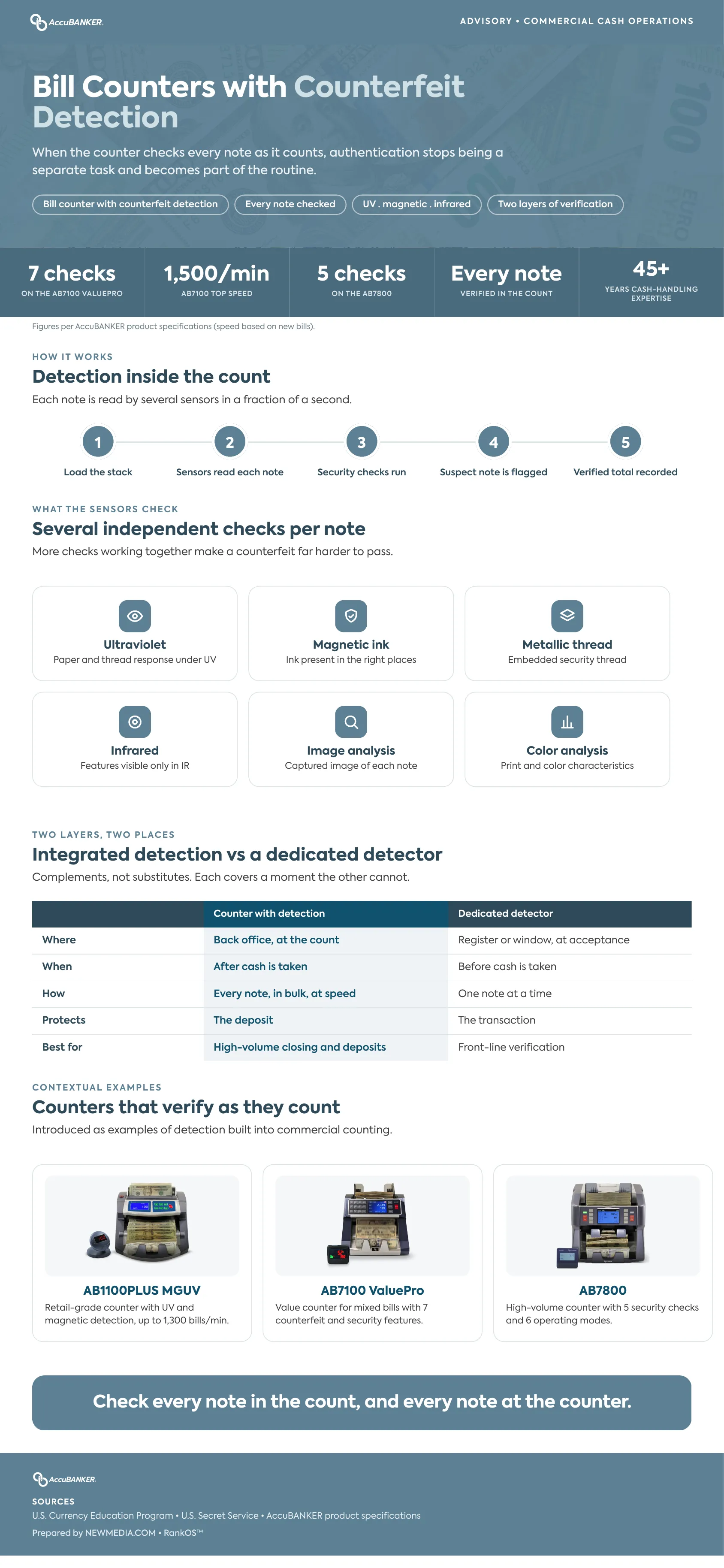
When a bill counter checks every note as it counts, authentication stops being a separate task and becomes part of the routine.
Bill counters with counterfeit detection, verification inside the count
MIAMI, FL, Nov. 04, 2026 (GLOBE NEWSWIRE) -- Counting and verifying used to be two jobs. A cashier counted the drawer, and anyone worried about a suspect note checked it separately, usually with a pen or by eye. Modern commercial bill counters combine the two. According to AccuBANKER, a provider of commercial cash-handling solutions with more than 45 years of industry experience, a bill counter with counterfeit detection checks each note against several security features while it counts, flags anything that fails, and does so at counting speed. The result is that every note in a deposit has been tested, not just the ones someone thought to look at.
A bill counter with counterfeit detection is a counting machine with built-in sensors that test banknotes for the security features found in genuine currency. When a note fails a check, the counter stops or diverts it so the operator can set it aside. It is different from a dedicated counterfeit detector, which verifies notes one at a time as its only job. The two tools work best together, and understanding where each fits is the key to placing verification where the risk actually is.
Key Facts
|
Industry Context: Why Verification Moved Into the Count
For decades, the practical defense against counterfeit notes was a person paying attention. The U.S. Secret Service and the Federal Reserve's currency education program both publish guidance on checking notes by feel, by tilting them, and by holding them to light. That guidance works, but it depends on time and attention, both of which are in short supply at closing time with a stack of several hundred notes.
At the same time, counterfeit notes have become easier to produce. News reports through 2025 and 2026 described bill-washing operations, counterfeit notes bought online and passed in retail stores, and large seizures at ports of entry. When a fake reaches the back office, the question is whether anyone will notice before it reaches the bank. Building verification into the counter answers that question with a machine instead of a hope.
Operational Insight
A person checks the notes they suspect. A counter with detection checks every note, which is the only way to catch the ones nobody suspected.
How Detection Works Inside a Counter
As each note passes through the counter, sensors read it in a fraction of a second. Different machines use different combinations of checks, and more checks generally mean fewer fakes slip through.
Ultraviolet
Genuine U.S. paper does not glow under ultraviolet light, while many counterfeit papers do. Security threads in genuine notes glow in specific colors under UV. An ultraviolet sensor looks for both signals.
Magnetic and metallic thread
Genuine notes are printed with magnetic ink in particular areas and carry an embedded security thread. Magnetic and thread sensors confirm that these features are present and in the right place, which is difficult for a counterfeiter to reproduce.
Infrared
Some features of genuine currency appear only in infrared light. Infrared sensors compare the note against those expected patterns.
Image and color analysis
More advanced counters capture an image of each note and analyze its color and print characteristics. Image analysis also lets a value counter recognize the denomination of each note, which is what allows it to total a mixed stack accurately.
Integrated Detection and Dedicated Detectors: Complements, Not Substitutes
Integrated detection and a dedicated counterfeit detector solve related problems in different places. A counter with detection works where cash is counted, usually at the end of a shift or before a deposit, and it checks notes in bulk. A dedicated detector works where cash is accepted, at the register or the service window, and it checks one note at a time before the customer leaves.
Each catches what the other cannot. A dedicated detector stops a counterfeit before it is accepted, when the loss can still be avoided. A counter with detection catches anything that got through at the front, before it is deposited and returned by the bank. A business that relies only on the counter learns about counterfeits after they have been accepted. A business that relies only on point-of-sale checks has no systematic second look. Together they form two layers of verification.
Which Fits Which Job
- High-volume back office: a counter with integrated detection, so every note in every deposit is checked at counting speed.
- Register, window, or event: a dedicated, often portable, detector to verify notes as they are taken.
- Mixed denominations: a value counter with detection, which recognizes and totals each denomination while checking it.
- Elevated counterfeit exposure: both layers, so a fake must pass two independent sets of checks to reach the bank.
Why Several Checks Beat One
Each security feature in genuine currency defeats a different kind of counterfeit. A note printed on ordinary office paper may fail an ultraviolet check but would not be caught by a check that looks only at size. A note printed on bleached genuine paper will pass a paper test but may fail magnetic, infrared, or image checks because the printing is wrong. Counterfeiters who manage to imitate one feature rarely imitate all of them.
That is why the number and variety of checks in a counter matter. A counter that applies several independent tests to every note forces a counterfeit to pass all of them at once, at counting speed, with no human judgment involved. Each added check closes a gap the others leave open.
Handling Flagged Notes
Detection is only half of the process. What happens to a flagged note determines whether the business learns anything from it. A sound procedure has a few simple steps.
- Stop and remove the flagged note, then recount it once to rule out a feeding error such as a folded or damaged note.
- If it is flagged again, set it aside in a marked envelope and record the date, shift, and register it came from.
- Do not return it to circulation or include it in the deposit.
- Report suspected counterfeits to local police or the U.S. Secret Service, following the guidance on the U.S. Currency Education Program's Report a Counterfeit page.
- Review where flagged notes came from over time; patterns point to the registers, shifts, or times of day that need verification at the point of acceptance.
Recording where flagged notes originated turns the counter into a source of intelligence as well as a safeguard. If several suspect notes come from the same register or the same busy evening shift, that is where a dedicated detector at the front counter will do the most good.
Detection and Value Counting Together
Many businesses count stacks of mixed denominations: twenties, fifties, and hundreds from a single drawer. A value counter recognizes each denomination as it counts and totals the stack, so the operator does not need to sort the cash first. When the same machine also checks every note for counterfeit features, a single pass produces a verified, itemized total. That combination saves the most time at closing, when staff would otherwise sort, count, and check suspect notes as three separate steps.
It also improves the quality of the record. A verified value count shows not only how much cash is in the drawer, but that every note in that total passed the same set of checks. For managers and bookkeepers reconciling deposits, that is a stronger figure than a total built from a manual count with spot checks.
Where Product Examples Fit
The AB7100 ValuePro, a value counter for mixed bills, checks each note with seven counterfeit and security features, including ultraviolet, magnetic, metallic-thread, infrared, image, and color analysis, and counts up to 1,500 bills per minute. The AB7800 applies five security checks, including ultraviolet, magnetic, metallic-thread, and infrared, across six operating modes for high-volume counting. Both sit within AccuBANKER's enterprise bill counter range. For verification at the point of acceptance, AccuBANKER's dedicated counterfeit detectors complete the second layer.
Executive Commentary
“The best part of detection in a counter is that it does not depend on anyone being suspicious,” said Matthew Peon, CEO of AccuBANKER. “Every note gets the same checks, whether it is the first of the day or the last one at closing.”
“We always tell customers that counters and detectors are teammates,” Peon added. “The detector protects the moment the cash is taken. The counter protects the deposit. You want both of those moments covered.”
Frequently Asked Questions
What is a bill counter with counterfeit detection?
A counting machine with built-in sensors that test each banknote for security features, such as ultraviolet, magnetic, and infrared characteristics, while it counts, and flags notes that fail.
Can a money counter detect fake bills?
Yes. Commercial counters with counterfeit detection check every note as it passes through. The more independent checks a counter uses, the harder it is for a counterfeit to pass.
Do I still need a counterfeit detector if my counter has detection?
Often, yes. The counter checks notes after they have been accepted, in the back office. A dedicated detector checks notes at the point of acceptance, before the loss occurs. They cover different moments.
Which counterfeit checks matter most in a bill counter?
Using several checks together matters more than any single one. Ultraviolet, magnetic, metallic-thread, and infrared checks cover the most common features, and image and color analysis add another layer.
What Businesses Should Review
A short review shows whether verification is happening where it should.
- Which security checks the current counter actually performs.
- Whether every note is verified, or only notes someone suspects.
- How flagged notes are separated, documented, and resolved.
- Whether verification also happens at the point of acceptance.
- Whether the counter recognizes mixed denominations accurately.
- How often counterfeit notes have been returned by the bank.
Looking Ahead
As counterfeit notes become easier to make, verification is moving from an occasional check to a routine one. Bill counters with counterfeit detection make that routine automatic in the back office, and dedicated detectors extend it to the front counter. Businesses that use both turn counterfeit defense from something that depends on vigilance into something built into the way cash is handled.
Related Resources
Sources
- U.S. Currency Education Program (Federal Reserve): banknote security features.
- U.S. Secret Service: counterfeit education guidance.
- News and law-enforcement reports on counterfeit cases, 2025 and 2026.
- AccuBANKER product specifications (AB7100 ValuePro, AB7800).
About AccuBANKER
AccuBANKER is a provider of commercial cash-handling solutions specializing in money counters, counterfeit detectors, coin counters, and related cash-management technologies. For more than 45 years, the company has helped organizations improve operational efficiency, reconciliation accuracy, and cash accountability through commercial-grade cash-handling infrastructure. AccuBANKER serves banks, retailers, restaurants, hospitality operators, casinos, cannabis dispensaries, and other cash-intensive businesses throughout North America.
For more information please visit: www.AccuBANKER.com
# # #







Comments (0)
Login to join the conversation
Login / RegisterNo comments yet. Be the first to comment!