
Six 2026 Oncology Deals Worth Up to About USD 59 Billion Reshape a USD 279.73 Billion Market: Precedence Research Company Intelligence on Top Players, Investments, Approvals and Pipelines
Ottawa, Nov. 13, 2026 (GLOBE NEWSWIRE) --
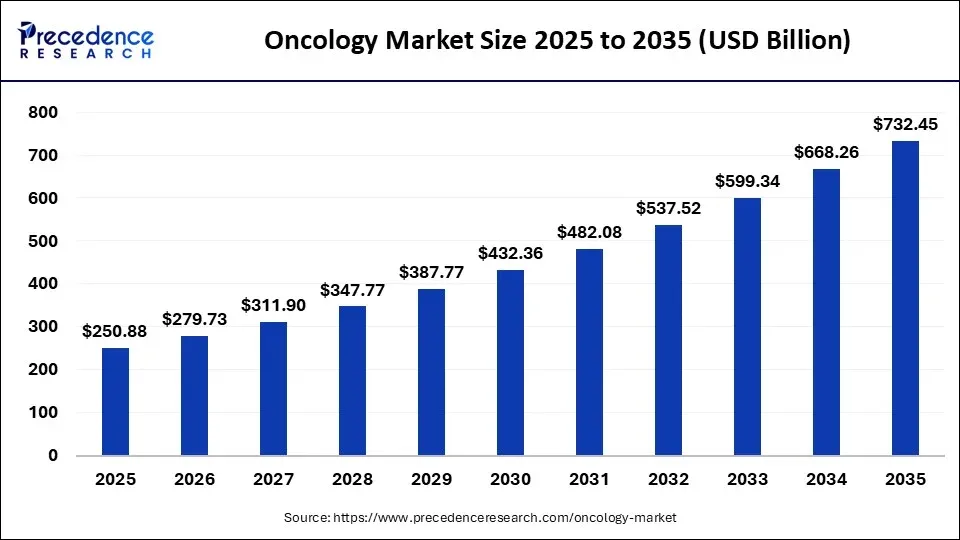
The global oncology market is valued at USD 279.73 billion in 2026, up from USD 250.88 billion in 2025, and is projected to reach USD 732.45 billion by 2035 at a CAGR of 11.31%. North America held 46% of 2025 revenue, and the U.S. market is set to grow from USD 81.26 billion in 2025 to USD 241.69 billion by 2035.
Precedence Research today released updated company intelligence on the global oncology market, covering cancer diagnostics and treatment, from chemotherapy and immunotherapy to targeted drugs, cell therapies, antibody drug conjugates and radiopharmaceuticals. The market is valued at USD 279.73 billion in 2026 and is forecast to reach USD 732.45 billion by 2035, adding USD 452.72 billion in annual revenue.
This release focuses on the companies. Oncology is the largest therapy area in the pharmaceutical industry, and the leaders are posting strong sales: AstraZeneca's oncology revenue reached USD 21.9 billion in the first nine months of 2026, up 16%, Merck's Keytruda sold USD 8.6 billion in the third quarter, and Johnson & Johnson's Darzalex grew 15% to USD 4.24 billion. At the same time, the industry faces a patent cliff. Keytruda's key U.S. patent begins to expire in 2028, and drugmakers are buying and licensing new assets to replace revenue.
The result is one of the busiest years for oncology dealmaking. In 2026, GSK agreed to buy Nuvalent for USD 10.6 billion, Gilead agreed to buy Arcellx for about USD 7.8 billion, Merck acquired Terns for about USD 6.7 billion, Pfizer signed a collaboration with Innovent worth up to USD 10.5 billion, Curium agreed to acquire Lantheus for up to about USD 8.0 billion, and Roche partnered with Hansoh in a deal that could exceed USD 15 billion. The sections below cover who leads, how they are investing and where competition is heading.
Full report: https://www.precedenceresearch.com/oncology-market
Request a sample: https://www.precedenceresearch.com/sample/1467
Market at a Glance: Size, Segments and Regions
| Market Indicator | Value |
| Market size, 2025 → 2026 | USD 250.88 billion → USD 279.73 billion |
| Market size, 2035 | USD 732.45 billion |
| CAGR, 2026–2035 | 11.31% |
| Absolute growth, 2026–2035 | USD 452.72 billion |
| U.S. market, 2025 → 2035 | USD 81.26 billion → USD 241.69 billion (11.52% CAGR) |
| Largest region, 2025 | North America (46%) |
| Leading segment, 2025 | Cancer treatment (about 56%) |
| Leading / fastest indication | Lung cancer / breast cancer |
| Fastest-growing end use | Hospitals (10.9% CAGR) |
Sources: Expert Interview, Secondary Sources, Precedence Research Database, Precedence Research Analysts and Researcher
Figure 1: Oncology Market Snapshot
Sources: Expert Interview, Secondary Sources, Precedence Research Database, Precedence Research Analysts and Researcher
Oncology Market: Key Segments
| Segment | 2025 Share | 2026 Value (modeled) | Growth Signal |
| Cancer treatment | ~56% | About USD 156.65 billion | Largest; immunotherapy, targeted drugs, ADCs |
| Cancer diagnostics and other | ~44% | About USD 123.08 billion | Most opportunistic; screening and molecular tests |
| North America (region) | 46% | About USD 128.68 billion | Largest region; U.S. drives launches |
Sources: Expert Interview, Secondary Sources, Precedence Research Database, Precedence Research Analysts and Researcher
2026 values apply the published 2025 shares to the 2026 market size of USD 279.73 billion. Lung cancer is the largest indication and breast cancer the fastest-growing, which explains why lung and breast assets dominate 2026 deals and approvals. Europe is described as the most opportunistic region, and Asia Pacific is expected to grow significantly as China becomes a major source of new cancer drugs.
Sources: Expert Interview, Secondary Sources, Precedence Research Database, Precedence Research Analysts and Researcher
Top Companies and Latest Performance
Figure 2: Top Oncology Companies, Latest Reported Performance
Sources: Expert Interview, Secondary Sources, Precedence Research Database, Precedence Research Analysts and Researcher
The oncology market is led by large drugmakers with broad portfolios. Precedence Research names AstraZeneca, Roche, Johnson & Johnson, Pfizer, Merck & Co., Bristol Myers Squibb, AbbVie, Amgen, Takeda Oncology and BioNTech among the key players, alongside specialty companies and start-ups such as Grail, Faeth Therapeutics and ImmunoACT.
| Company | Key Oncology Brands | Latest Reported Data | Strategic Direction |
| Merck & Co. | Keytruda, Keytruda Qlex, Welireg | Q3 2026 Keytruda sales USD 8.6B (+6%); Qlex USD 830M | Subcutaneous switch; Terns (CML); sac-TMT ADC; mRNA vaccine with Moderna |
| AstraZeneca | Tagrisso, Imfinzi, Enhertu, Datroway, Calquence | 9M 2026 oncology revenue USD 21.9B (+16%), 47% of total | ADC and early-line expansion; Enhertu and Datroway approvals (May 2026) |
| Johnson & Johnson | Darzalex, Carvykti, Tecvayli, Rybrevant | Q3 2026 Darzalex USD 4.24B (+15%); Tecvayli USD 312M (+77%) | Myeloma leadership; bispecifics in earlier lines |
| Bristol Myers Squibb | Opdivo, Opdivo Qvantig, Breyanzi | Q3 2026 growth portfolio +12%; 2026 revenue guide USD 49.75–50.25B | Subcutaneous Opdivo; cell therapy growth |
| Roche | Kadcyla, Polivy, Tecentriq | Hansoh collaboration could exceed USD 15B (Oct 2026) | China-sourced pipeline; degrader conjugates with C4T |
| Pfizer | Padcev, Adcetris, Ibrance | Innovent collaboration up to USD 10.5B (Jun 2026) | ADCs and multi-specifics after Seagen |
| Novartis | Pluvicto, Lutathera, Kisqali | Q3 2026 Pluvicto USD 674M (+20%) | Radioligand therapy; mHSPC approval (Jul 2026) |
| GSK | Jemperli, Zejula, Blenrep | Nuvalent acquisition USD 10.6B (Jun 2026) | Lung cancer targeted therapy |
| Gilead | Trodelvy, Yescarta | Arcellx acquisition ~USD 7.8B (Feb 2026) | CAR-T in multiple myeloma |
| AbbVie | Venclexta, Elahere, Decnupaz | Decnupaz approved May 27, 2026 | ADCs in blood and ovarian cancers |
Sources: Expert Interview, Secondary Sources, Precedence Research Database, Precedence Research Analysts and Researcher
The leaders share three traits: a blockbuster immunotherapy or targeted franchise, a growing ADC or cell therapy business, and the cash flow to buy new assets. Merck and Bristol Myers Squibb are converting patients to under-the-skin versions of Keytruda and Opdivo to extend their franchises, while AstraZeneca is growing fastest among the leaders on the back of a broad portfolio.
Sources: Expert Interview, Secondary Sources, Precedence Research Database, Precedence Research Analysts and Researcher
Investments and Deals: How the Leaders Are Rebuilding Pipelines
Figure 3: Largest Oncology Deals Announced in 2026
Sources: Expert Interview, Secondary Sources, Precedence Research Database, Precedence Research Analysts and Researcher
| Date | Acquirer / Partner | Target | Value | Asset / Focus |
| Feb 2026 | Gilead | Arcellx | About USD 7.8B | Anito-cel CAR-T for multiple myeloma |
| Mar–Apr 2026 | Merck | Terns Pharmaceuticals | About USD 6.7B | TERN-701 oral therapy for CML |
| Jun 2026 | GSK | Nuvalent | USD 10.6B (cash, ~40% premium) | Zidesamtinib and neladalkib for lung cancer |
| Jun 2026 | Pfizer | Innovent | Up to USD 10.5B (USD 650M upfront) | ADCs with novel payloads, multi-specifics |
| Aug 2026 | Curium | Lantheus | Up to about USD 8.0B | Radiopharmaceutical diagnostics and therapy |
| Oct 2026 | Roche | Hansoh | Could exceed USD 15B | China-sourced oncology pipeline |
Sources: Expert Interview, Secondary Sources, Precedence Research Database, Precedence Research Analysts and Researcher
Together these six deals carry a potential value of up to about USD 59 billion. Three patterns stand out:
- Patent-cliff replacement: Keytruda generated roughly USD 31.7 billion in 2025, close to half of Merck's revenue, and its U.S. compound patent begins expiring in December 2028. Merck's Terns deal and its ADC and vaccine programs aim to fill that gap.
- Lung cancer and blood cancers: GSK's Nuvalent purchase targets lung cancer, the largest indication, while Gilead's Arcellx and Merck's Terns deals target myeloma and leukemia.
- China as a source of innovation: Pfizer–Innovent and Roche–Hansoh show that Western drugmakers are licensing Chinese assets at scale, mainly ADCs and multi-specific antibodies.
Sources: Expert Interview, Secondary Sources, Precedence Research Database, Precedence Research Analysts and Researcher
Key Company Developments
Figure 4: Key Oncology Company Developments, 2026
Sources: Expert Interview, Secondary Sources, Precedence Research Database, Precedence Research Analysts and Researcher
Approvals are moving therapies into earlier disease. In May 2026, the FDA approved AstraZeneca and Daiichi Sankyo's Enhertu for two early-stage HER2-positive breast cancer settings and Datroway as first-line therapy for metastatic triple-negative breast cancer. On July 31, 2026, Novartis's Pluvicto was approved for metastatic hormone-sensitive prostate cancer, nearly doubling its eligible population.
What it indicates: Earlier-line approvals expand treated populations and lengthen therapy, a key driver of the 11.31% market CAGR.
New modalities are winning approvals. AbbVie's Decnupaz became the first ADC for blastic plasmacytoid dendritic cell neoplasm (May 2026). J&J's bispecific Tecvayli grew 77% in the third quarter of 2026.
What it indicates: ADCs, bispecifics, cell therapies and radioligands are taking share from older chemotherapy and single-target drugs.
Subcutaneous versions are protecting franchises. Keytruda Qlex generated USD 830 million in the third quarter of 2026, and Bristol Myers Squibb says Opdivo Qvantig is growing quickly.
What it indicates: Faster, under-the-skin dosing helps leaders keep patients ahead of biosimilar competition.
Diagnostics are becoming more strategic. Precedence Research identifies cancer diagnostics as the most opportunistic area, and Curium's planned acquisition of Lantheus combines PSMA PET imaging with therapy.
What it indicates: Companies that pair tests with treatments (theranostics and companion diagnostics) will capture more of the patient journey.
Sources: Expert Interview, Secondary Sources, Precedence Research Database, Precedence Research Analysts and Researcher
Key Market Drivers
- Rising cancer incidence: new cases are projected to rise 47% between 2020 and 2040.
- Innovation in precision medicine, ADCs, cell therapies and radioligands.
- Earlier screening and cancer diagnostics that find more treatable disease.
- Strong cash flows that fund acquisitions and licensing deals.
- Use of artificial intelligence in oncology for drug discovery, imaging and trial design.
Sources: Expert Interview, Secondary Sources, Precedence Research Database, Precedence Research Analysts and Researcher
Major Challenges
- Patent expiries for top brands, led by Keytruda from 2028.
- High drug prices and growing price controls in the U.S. and Europe.
- Complex manufacturing for cell therapies, ADCs and radiopharmaceuticals.
- Rising competition from Chinese developers and biosimilars.
- High late-stage trial failure rates and costs.
Sources: Expert Interview, Secondary Sources, Precedence Research Database, Precedence Research Analysts and Researcher
Emerging Opportunities
- Breast cancer, the fastest-growing indication, through ADCs and targeted therapy.
- Cancer diagnostics, the most opportunistic segment, including liquid biopsy and multi-cancer early detection.
- Hospitals, the fastest-growing end use at a 10.9% CAGR, as complex therapies concentrate in large centers.
- China licensing for global rights to novel ADCs and multi-specifics.
- Cancer vaccines and radioligands as next-generation modalities.
Sources: Expert Interview, Secondary Sources, Precedence Research Database, Precedence Research Analysts and Researcher
Company Ecosystem
Figure 5: Oncology Company Ecosystem, 2026
Sources: Expert Interview, Secondary Sources, Precedence Research Database, Precedence Research Analysts and Researcher
The supply side combines large drugmakers, biotech innovators (many now acquired or partnered) and diagnostics, imaging and service providers. The demand side includes hospitals and cancer centers, payers, specialty distribution and research bodies. Deals in 2026 moved several biotechs, including Nuvalent, Arcellx, Terns and Lantheus, into larger companies' portfolios.
Customer and Buyer Intelligence
| Target Account Group | Decision-Makers | Purchase Signals | Commercial Opportunity |
| Pharma business development | Head of BD, Oncology R&D Head | Patent expiries, pipeline gaps | Licensing and M&A targets |
| Biotech companies | CEO, CSO, CFO | Funding needs, late-stage data | Partnering and exit strategy |
| Hospitals and cancer centers | Oncology Director, Pharmacy & Therapeutics Committee | New approvals, capacity limits | Infusion, cell therapy and radioligand programs |
| Payers | Medical Director, HTA Lead | Early-line approvals, budget impact | Outcomes-based contracts |
| Diagnostics companies | BD Head, Commercial Lead | Companion diagnostic needs | Test–drug partnerships |
Sources: Expert Interview, Secondary Sources, Precedence Research Database, Precedence Research Analysts and Researcher
How Precedence Research Supports Decision-Making
Master Dataset provides segment, regional and company data for oncology and adjacent markets such as the cancer drugs, cancer therapeutics and precision oncology markets. It helps teams size demand by indication, modality and region.
Precedence Quadrant compares oncology companies on portfolio strength, pipeline, deal activity and patent exposure, helping business development teams screen partners and targets.
Interactive Intelligence Dashboard tracks approvals, deals, earnings and trial readouts, so strategy teams can respond to competitor moves quickly.
Quality & Manufacturing Intelligence maps manufacturing capacity for biologics, ADCs, cell therapies and radiopharmaceuticals, supporting sourcing and partnering decisions.
Customized Research answers specific questions, such as patent-cliff exposure by company, China licensing valuations or the outlook for a given tumor type.
| Solution | What It Provides | How It Helps |
| Master Dataset | Segment, region and company data on oncology | Sizes demand by indication and modality |
| Precedence Quadrant | Company comparison on portfolio, pipeline and deals | Screens partners and acquisition targets |
| Interactive Dashboard | Live tracking of approvals, deals and earnings | Times BD, launch and investment decisions |
| Quality & Manufacturing Intelligence | Biologics, ADC, cell and radiopharma capacity | Supports manufacturing partner choices |
| Customized Research | Patent-cliff, licensing and tumor-type studies | Answers decision-specific questions |
Sources: Expert Interview, Secondary Sources, Precedence Research Database, Precedence Research Analysts and Researcher
Why Continuously Updated Intelligence Matters
Oncology changes faster than almost any other therapy area. Monthly updates suit business development teams tracking deals, approvals and trial data. Quarterly updates match company earnings, such as Keytruda, Darzalex and AstraZeneca oncology sales. Six-monthly updates align with major congresses such as ASCO and ESMO, and annual updates support investors reviewing market size, share and patent exposure. Precedence Research offers all four update cycles.
Strategic Outlook
- CEOs and CXOs: the market adds USD 452.72 billion by 2035, but patent expiries mean growth must be bought or built now.
- Strategy and business development teams: 2026 deals worth up to about USD 59 billion set valuation benchmarks for lung cancer, CAR-T, ADC and radiopharma assets.
- R&D leaders: focus on breast and lung cancer, ADCs, bispecifics and radioligands, where approvals are moving into earlier lines.
- Procurement and supply teams: secure capacity for ADC conjugation, cell therapy and isotopes as new modalities scale.
- Investors: biotechs with late-stage lung, myeloma and ADC assets are prime acquisition targets.
- Diagnostics and service providers: pair tests with therapies to capture value in the most opportunistic segment.
Sources: Expert Interview, Secondary Sources, Precedence Research Database, Precedence Research Analysts and Researcher
Call to Action
To understand which oncology companies, deals and modalities will lead through 2035, explore the full report or speak with a Precedence Research analyst.
- Report: https://www.precedenceresearch.com/oncology-market
- Request a sample: https://www.precedenceresearch.com/sample/1467
- Schedule a meeting: https://www.precedenceresearch.com/schedule-meeting
Fill out the form for relevant samples, case studies, and examples. sales@precedenceresearch.com
Related Reports
- Cancer Drugs Market: https://www.precedenceresearch.com/cancer-drugs-market
- Cancer Therapeutics Market: https://www.precedenceresearch.com/cancer-therapeutics-market
- Precision Oncology Market: https://www.precedenceresearch.com/precision-oncology-market
- Cancer Diagnostics Market: https://www.precedenceresearch.com/cancer-diagnostics-market
- Oncology Molecular Diagnostic Market: https://www.precedenceresearch.com/oncology-molecular-diagnostic-market
- Artificial Intelligence in Oncology Market: https://www.precedenceresearch.com/artificial-intelligence-in-oncology-market
- Non-Oncology Precision Medicine Market: https://www.precedenceresearch.com/non-oncology-precision-medicine-market
- Precision Medicine Market: https://www.precedenceresearch.com/precision-medicine-market
- Chemotherapy Market: https://www.precedenceresearch.com/chemotherapy-market
- Antibody Drug Conjugates Market: https://www.precedenceresearch.com/antibody-drug-conjugates-market
- Radiopharmaceuticals Market: https://www.precedenceresearch.com/radiopharmaceuticals-market
- Nuclear Medicine Market: https://www.precedenceresearch.com/nuclear-medicine-market
- Monoclonal Antibodies Market: https://www.precedenceresearch.com/monoclonal-antibodies-market
- Cancer Monoclonal Antibodies Market: https://www.precedenceresearch.com/cancer-monoclonal-antibodies-market
- Bispecific Antibodies Market: https://www.precedenceresearch.com/bispecific-antibodies-market
- Antibody Therapy Market: https://www.precedenceresearch.com/antibody-therapy-market
- Clinical Trials Market: https://www.precedenceresearch.com/clinical-trials-market
- Biopharmaceutical Market: https://www.precedenceresearch.com/biopharmaceutical-market
- Pharmaceutical Market: https://www.precedenceresearch.com/pharmaceutical-market
- Biotechnology Market: https://www.precedenceresearch.com/biotechnology-market
About Precedence Research
Precedence Research is a global market intelligence and consulting company. It provides market sizing and forecasts, competitive and company analysis, customer and buyer intelligence and customized research across healthcare, pharmaceuticals, biotechnology, ICT, energy, chemicals and materials and other industries, helping executives and investors make evidence-based decisions.
Our Partners
- Towards Healthcare: https://www.towardshealthcare.com/
- Towards Packaging: https://www.towardspackaging.com/
- Towards Chemical & Materials: https://www.towardschemandmaterials.com/
Connect With Us
- USA: +1 804 441 9344
- APAC: +61 485 981 310 or +91 87933 22019
- Singapore: +65 3105 1271
- Europe: +44 7383 092 044
- Email: sales@precedenceresearch.com
Social Media




Comments (0)
Login to join the conversation
Login / RegisterNo comments yet. Be the first to comment!