
Market Grows at 18.1% CAGR From USD 10.44 Billion in 2026; Cell Therapy Holds 65%, Oncology 39% and North America ~50% of Revenue: Precedence Research Segment, Company and Buyer Intelligence
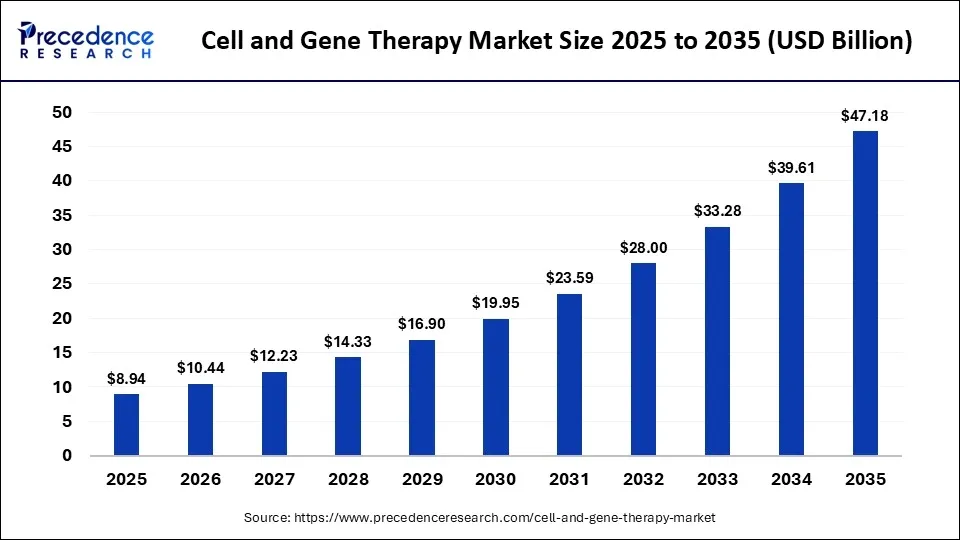
Ottawa, Nov. 24, 2026 (GLOBE NEWSWIRE) -- The global cell and gene therapy market is valued at USD 10.44 billion in 2026, up from USD 8.94 billion in 2025, and is projected to reach USD 47.18 billion by 2035 at a CAGR of 18.1%. The U.S. market grows from USD 4.74 billion in 2026 to about USD 20 billion by 2035.
Sources: Expert Interview, Secondary Sources, Precedence Research Database, Precedence Research Analysts and Researcher
Precedence Research today released updated intelligence on the global cell and gene therapy market, covering CAR-T and other cell therapies, gene therapies and gene-editing therapies across oncology, genetic, musculoskeletal, neurological, cardiovascular and eye diseases. The market is valued at USD 10.44 billion in 2026 and is forecast to reach USD 47.18 billion by 2035, adding USD 36.74 billion in annual revenue.
Access is widening. On July 2, 2026, the FDA expanded Vertex's CRISPR-based therapy Casgevy to children aged 2 and older with severe sickle cell disease or transfusion-dependent beta thalassemia, which Vertex says could make about 5,500 more U.S. children eligible. The CMS Cell and Gene Therapy Access Model, which links payment to outcomes, now includes 33 states plus the District of Columbia and Puerto Rico.
The field is also changing shape. July 2026 saw the first international patient treated with the first CAR-T approved for a solid tumor, ARPA-H committed up to USD 160 million to scalable in vivo gene editing, and established CAR-T products face rising competition. For developers, CDMOs, tool suppliers, treatment centers and payers, the questions are how to scale manufacturing, how to pay for one-time therapies, and which modalities lead the next wave.
Request a sample: https://www.precedenceresearch.com/sample/2445
Figure 1: Cell and Gene Therapy Market Snapshot
Sources: Expert Interview, Secondary Sources, Precedence Research Database, Precedence Research Analysts and Researcher
The market grows more than four times between 2026 and 2035. Growth comes from new approvals, earlier-age and earlier-line use, wider reimbursement and lower-cost manufacturing.
Segment Intelligence: Dominant Segments and Shares
Cell and Gene Therapy Market: Segment Shares, 2025
| Segment Group | Leading Segment | Next Segments | Why It Matters |
| Therapy type | Cell therapy (65%) | Gene therapy (35%) | CAR-T revenue leads; gene editing rising |
| Indication | Oncology (39%) | Musculoskeletal (21%); genetic disorders (12%) | Blood cancers lead; rare disease grows |
| Vector type | Viral vectors (72%) | Non-viral vectors (28%) | Viral supply and cost remain key |
| Manufacturing | In-house (46%) | CDMOs (39%); hybrid (16%) | Outsourcing grows as pipelines expand |
| End user | Hospitals & specialty clinics (63%) | Cancer centers (24%); research institutes (13%) | Authorized centers control access |
Sources: Expert Interview, Secondary Sources, Precedence Research Database, Precedence Research Analysts and Researcher
Therapy type. Cell therapy held 65% of revenue in 2025, led by CAR-T products for blood cancers. Gene therapy held 35% and is gaining as gene-editing products such as Casgevy expand to younger patients.
Indication. Oncology led with 39%, followed by musculoskeletal and orthopedic uses at 21% and genetic disorders at 12%. Neurological, cardiovascular and eye diseases are earlier-stage areas with active pipelines.
Vector and manufacturing. Viral vectors held 72% and non-viral approaches 28%. In-house manufacturing held 46%, while CDMOs held 39% as smaller developers outsource production.
End user. Hospitals and specialty clinics held 63%, cancer treatment centers 24% and research institutes 13%.
Sources: Expert Interview, Secondary Sources, Precedence Research Database, Precedence Research Analysts and Researcher
Regional and Country Analysis
Cell and Gene Therapy Market by Region
| Region | Position | Key Facts | Growth Signal |
| North America | Largest (~50.26%) | U.S. USD 4.74B (2026) → ~USD 20B (2035) | FDA approvals; CMS access model |
| Europe | Established | Vertex Casgevy reimbursement deal in Germany (May 2026) | National reimbursement agreements |
| Asia Pacific | Expanding | India training program and new CRDMO (Nov 2025) | Local manufacturing and lower-cost CAR-T |
| Latin America and MEA | Emerging | Licensing deals for gene therapies in MENA | Access through partnerships |
Sources: Expert Interview, Secondary Sources, Precedence Research Database, Precedence Research Analysts and Researcher
North America. North America held about 50.26% of revenue in 2025. The U.S. market grows from USD 4.74 billion in 2026 to about USD 20 billion by 2035 at a 17.21% CAGR, supported by FDA approvals and the CMS outcomes-based access model for Medicaid patients.
Europe. Reimbursement agreements are opening access; Vertex signed a Casgevy agreement with Germany's statutory health insurers in May 2026.
Asia Pacific. In November 2025, BRIC-THSTI, Miltenyi Biotec and BIRAC launched India's first hands-on cell and gene therapy manufacturing training program, and Bharat Biotech launched Nucelion Therapeutics as a CRDMO in Hyderabad. Lower-cost local CAR-T production is widening access.
Latin America and Middle East & Africa. Licensing deals, such as Ocugen's term sheet for its retinitis pigmentosa gene therapy in the Middle East and North Africa, are bringing therapies to new markets.
Sources: Expert Interview, Secondary Sources, Precedence Research Database, Precedence Research Analysts and Researcher
What Is Changing in the Industry
Figure 2: Key Cell and Gene Therapy Developments, 2025–2026
Sources: Expert Interview, Secondary Sources, Precedence Research Database, Precedence Research Analysts and Researcher
Gene editing reaches younger children. The FDA expanded Casgevy on July 2, 2026 to patients aged 2 and older, making it the first genetic therapy approved for children this young for both severe sickle cell disease and transfusion-dependent beta thalassemia.
What it indicates: Treating earlier, before organ damage builds, enlarges the eligible population and strengthens the value case for one-time therapies.
Payers are adopting outcomes-based models. The CMS Cell and Gene Therapy Access Model went live with 33 states, the District of Columbia and Puerto Rico, starting with sickle cell gene therapies from Vertex and bluebird bio.
What it indicates: Outcomes-based payment lowers the budget barrier for Medicaid and may become a template for other high-cost therapies.
New modalities are moving forward. July 2026 brought the first international patient treated with satri-cel, the first CAR-T approved for a solid tumor, FDA clearance of in vivo CAR-T trials, and ARPA-H funding of up to USD 160 million for in vivo gene editing.
What it indicates: In vivo and solid-tumor approaches could remove the need for complex cell manufacturing and open much larger patient groups.
Competition is reshaping CAR-T. Gilead reported Kite cell therapy sales down 18% year over year in Q3 2026 on competitive pressure, while its multiple myeloma CAR-T anito-cel has an FDA decision date of December 23, 2026.
What it indicates: Share is shifting between products and indications; earlier-line use and faster manufacturing decide winners.
Sources: Expert Interview, Secondary Sources, Precedence Research Database, Precedence Research Analysts and Researcher
Key Market Drivers
- Growing number of approved therapies and label expansions.
- High burden of cancer and rare genetic diseases.
- Outcomes-based payment and national reimbursement deals.
- Expansion of clinical trials and biopharmaceutical investment.
- Use of artificial intelligence in design and manufacturing.
Sources: Expert Interview, Secondary Sources, Precedence Research Database, Precedence Research Analysts and Researcher
Major Challenges
- Very high one-time treatment prices.
- Complex, slow and costly manufacturing.
- Limited number of authorized treatment centers.
- Safety monitoring and long-term follow-up requirements.
- Viral vector supply and quality.
Sources: Expert Interview, Secondary Sources, Precedence Research Database, Precedence Research Analysts and Researcher
Emerging Opportunities
- In vivo gene editing and in vivo CAR-T, which avoid external cell processing.
- Solid-tumor cell therapies, a much larger patient pool.
- CDMO and automated manufacturing as outsourcing grows.
- Non-viral delivery, already 28% of revenue.
- Asia Pacific local manufacturing and lower-cost therapies.
Sources: Expert Interview, Secondary Sources, Precedence Research Database, Precedence Research Analysts and Researcher
Company and Competitive Intelligence
Figure 3: Cell and Gene Therapy Signals, 2026
Sources: Expert Interview, Secondary Sources, Precedence Research Database, Precedence Research Analysts and Researcher
Precedence Research profiles Alnylam Pharmaceuticals, Amgen, Biogen, CORESTEM, Dendreon Pharmaceuticals, Helixmith, JCR Pharmaceuticals, Kolon TissueGene, Novartis and Pfizer.
| Company | Key Offering | Latest Development | Positioning |
| Vertex / CRISPR Therapeutics | Casgevy gene-editing therapy | FDA expansion to ages 2+ (Jul 2026); Germany deal (May 2026) | Gene-editing leader |
| Gilead (Kite) | Yescarta, Tecartus CAR-T | Q3 2026 cell therapy sales -18%; anito-cel decision Dec 23, 2026 | CAR-T pioneer under pressure |
| Novartis | Cell and gene therapies | Named key player | Broad portfolio |
| Pfizer / Amgen / Biogen | Gene therapy and biologics | Named key players | Large-pharma reach |
| Alnylam | Genetic medicines | Named key player | RNA-based genetic therapies |
| Kolon TissueGene / CORESTEM / Helixmith / JCR | Cell and gene therapies | Named key players | Asia Pacific developers |
| Miltenyi Biotec / Nucelion | Tools and CRDMO services | India training and CRDMO launch (Nov 2025) | Manufacturing enablers |
Sources: Expert Interview, Secondary Sources, Precedence Research Database, Precedence Research Analysts and Researcher
Customer and Buyer Intelligence
| Target Account Group | Decision-Makers | Purchase Signals | Commercial Opportunity |
| Authorized treatment centers | Program Director, Transplant Chief | New approvals, age expansions | Patient onboarding and logistics |
| Biotech developers | CEO, CMC Head | IND filings, pivotal trials | CDMO, vector and tools contracts |
| Large pharma | BD and Licensing Head | Pipeline gaps, competition | Licensing and acquisitions |
| Payers and Medicaid | Medical Director, Pharmacy Director | Access models, outcomes data | Outcomes-based contracts |
| Governments and research bodies | Program Managers | Funding programs such as ARPA-H | Platform and manufacturing research |
Sources: Expert Interview, Secondary Sources, Precedence Research Database, Precedence Research Analysts and Researcher
How Precedence Research Supports Decision-Making
Master Dataset provides segment, regional and company data for cell and gene therapy and adjacent markets such as the cell and gene therapy CDMO, stem cell therapy and cell therapy manufacturing markets. It helps teams size demand by therapy type, indication and region.
Precedence Quadrant compares developers and CDMOs on pipeline, manufacturing capacity and commercial reach, supporting partner selection and benchmarking.
Interactive Intelligence Dashboard tracks approvals, decision dates, reimbursement deals and trial readouts so teams can act early.
Quality & Manufacturing Intelligence maps vector, cell processing and CDMO capacity, supporting sourcing and scale-up plans.
Customized Research answers specific questions, such as patient-eligibility models, pricing and access scenarios or regional entry plans.
| Solution | What It Provides | How It Helps |
| Master Dataset | Segment, region and company data | Sizes demand by therapy and indication |
| Precedence Quadrant | Developer and CDMO comparison | Supports partner selection |
| Interactive Dashboard | Live tracking of approvals and access deals | Times launch and investment moves |
| Quality & Manufacturing Intelligence | Vector and CDMO capacity mapping | Supports scale-up planning |
| Customized Research | Eligibility, pricing and entry studies | Answers decision-specific questions |
Sources: Expert Interview, Secondary Sources, Precedence Research Database, Precedence Research Analysts and Researcher
Why Continuously Updated Intelligence Matters
Approvals, label changes and reimbursement deals arrive throughout the year. Monthly updates suit teams tracking FDA decision dates and access agreements. Quarterly updates match company sales results. Six-monthly updates align with major hematology and gene therapy meetings, and annual updates support investors reviewing market size and share. Precedence Research offers all four update cycles.
Strategic Outlook
- CEOs and CXOs: the market grows more than four times by 2035; access and manufacturing scale are the main levers.
- Strategy and business development teams: in vivo, solid-tumor and gene-editing assets are the next licensing targets.
- R&D leaders: non-viral delivery and in vivo approaches can cut cost and complexity.
- Manufacturing and CMC teams: CDMO capacity and automation decide launch speed.
- Investors: label expansions and outcomes-based payment widen revenue potential.
- Payers: outcomes-based models offer a way to budget for one-time therapies.
Sources: Expert Interview, Secondary Sources, Precedence Research Database, Precedence Research Analysts and Researcher
Company Ecosystem
Figure 4: Cell and Gene Therapy Company Ecosystem, 2026
Sources: Expert Interview, Secondary Sources, Precedence Research Database, Precedence Research Analysts and Researcher
Call to Action
To understand how approvals, access models and manufacturing will shape cell and gene therapy through 2035, explore the full report or speak with a Precedence Research analyst.
- Report: https://www.precedenceresearch.com/cell-and-gene-therapy-market
- Request a sample: https://www.precedenceresearch.com/sample/2445
- Schedule a meeting: https://www.precedenceresearch.com/schedule-meeting
Fill out the form for relevant samples, case studies, and examples. sales@precedenceresearch.com
Related Reports
- Cell Therapy Market: https://www.precedenceresearch.com/cell-therapy-market
- Gene Therapy Market: https://www.precedenceresearch.com/gene-therapy-market
- U.S. Cell and Gene Therapy Market: https://www.precedenceresearch.com/us-cell-and-gene-therapy-market
- Stem Cell Therapy Market: https://www.precedenceresearch.com/stem-cell-therapy-market
- Cell and Gene Therapy CDMO Market: https://www.precedenceresearch.com/cell-and-gene-therapy-cdmo-market
- Cell and Gene Therapy Manufacturing Market: https://www.precedenceresearch.com/cell-and-gene-therapy-manufacturing-market
- Cell and Gene Therapy Clinical Trials Market: https://www.precedenceresearch.com/cell-and-gene-therapy-clinical-trials-market
- Cell Therapy Manufacturing Market: https://www.precedenceresearch.com/cell-therapy-manufacturing-market
- Automated and Closed Cell Therapy Processing System Market: https://www.precedenceresearch.com/automated-and-closed-cell-therapy-processing-system-market
- Cell Cryopreservation Market: https://www.precedenceresearch.com/cell-cryopreservation-market
- Cell and Tissue Preservation Market: https://www.precedenceresearch.com/cell-and-tissue-preservation-market
- Cell Lysis Disruption Market: https://www.precedenceresearch.com/cell-lysis-disruption-market
- Clinical Trials Market: https://www.precedenceresearch.com/clinical-trials-market
- Pharmaceutical Market: https://www.precedenceresearch.com/pharmaceutical-market
- Biopharmaceutical Market: https://www.precedenceresearch.com/biopharmaceutical-market
- Oncology Market: https://www.precedenceresearch.com/oncology-market
- Personalized Medicine Market: https://www.precedenceresearch.com/personalized-medicine-market
- Biotechnology Market: https://www.precedenceresearch.com/biotechnology-market
- Healthcare Automation Market: https://www.precedenceresearch.com/healthcare-automation-market
- Artificial Intelligence Market: https://www.precedenceresearch.com/artificial-intelligence-market
About Precedence Research
Precedence Research is a global market intelligence and consulting company. It provides market sizing and forecasts, competitive and company analysis, customer and buyer intelligence and customized research across healthcare, medical devices, ICT, energy, chemicals and materials and other industries, helping executives and investors make evidence-based decisions.
Our Partners
- Towards Healthcare: https://www.towardshealthcare.com/
- Towards Packaging: https://www.towardspackaging.com/
- Towards Chemical & Materials: https://www.towardschemandmaterials.com/
Connect With Us
- USA: +1 804 441 9344
- APAC: +61 485 981 310 or +91 87933 22019
- Singapore: +65 3105 1271
- Europe: +44 7383 092 044
- Email: sales@precedenceresearch.com
Social Media






Comments (0)
Login to join the conversation
Login / RegisterNo comments yet. Be the first to comment!